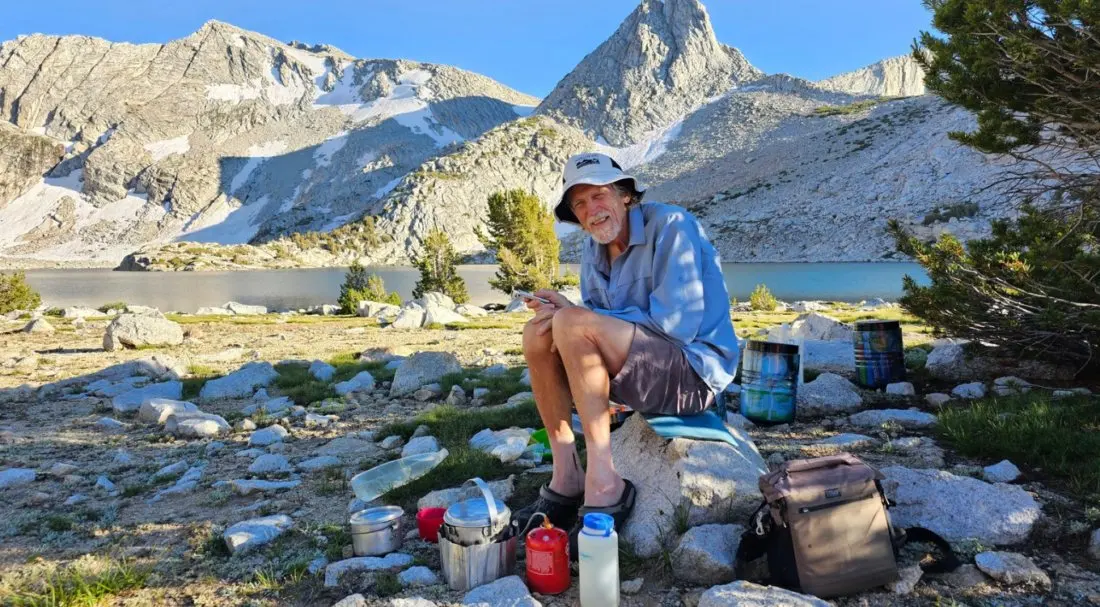
Forty-five years separate Wild magazine's first issue from its most recent — and John Chapman wrote for both. That alone says something about the endurance of Australia's most quietly influential bushwalker, a man who has spent, by his own count, more than 3,500 days on overnight walks, roughly a third of them in Tasmania.
Chapman's story starts far from the trail. Born in Geelong in 1953 to working-class parents, he was effectively abandoned by both of them at around age nine and raised by relatives. Bushwalking entered his life in 1971 on a weekend trip to Lerderderg Gorge, and it stuck. He co-founded a walking club, climbed more than 500 routes during Australia's 1970s climbing boom — including fifty first ascents — and eventually decided engineering wasn't for him, working in Melbourne gear shops instead while guiding trips to Tasmania, Nepal and India.
The guidebook empire began almost by accident. As a shop assistant, Chapman was handing out updated track notes for Tasmania's rarely visited southwest, and publisher John Brownlee told him his information was better than anything in print. The result was South West Tasmania, self-published in 1978 after a seven-week fact-checking trip, and still in print nearly five decades and six editions later. He then teamed up with John Siseman, and in 1983 met Monica — then a bushwalking club secretary — at a talk promoting his own book. They married in 1985 and have co-authored every guide since 1988, fourteen books together out of fifteen.
The couple's contribution goes well beyond publishing: hundreds of articles, nearly 300 columns for the Age, a combined century of bushwalking club membership, and decades of volunteering with Bush Search and Rescue — Monica for 34 years, much of it leading the group. John also became a computer science lecturer at RMIT, a career Monica engineered, whose long holidays fuelled the fieldwork.
Why should a traveller care? Because if you've ever relied on a track guide for Tasmania's southwest, the Overland Track country, or dozens of other Australian routes, the odds are good it was a Chapman book in your pack. Their notes are famous for being accurate, honest and confidence-building — the kind that let less experienced walkers attempt trips they'd otherwise skip. The interview, published in Wild's 200th issue, is a warm portrait of two people who built a life, a marriage and a body of work around wild places, without ever chasing the spotlight that usually comes with it.
For anyone planning an Australian walking holiday, it's a reminder of how much of the country's walking culture rests on a couple of meticulous Melburnians with rain-soaked notebooks — and a nudge to seek out their guides before your next Tassie trek.