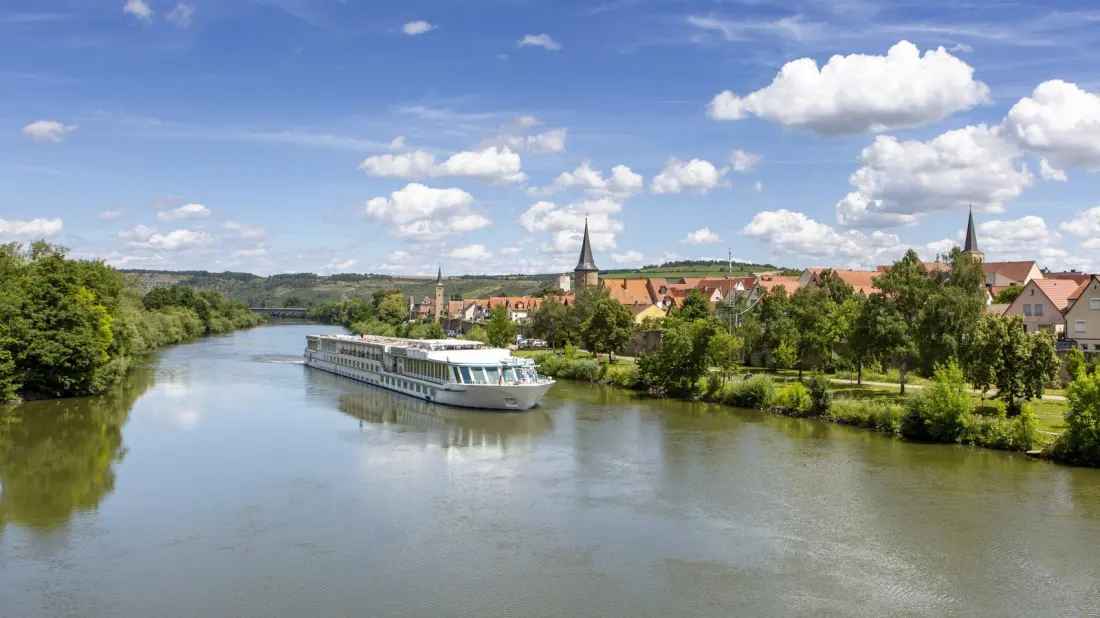
Europe's great rivers get all the attention — the Rhine, the Danube, the Moselle — but the towns strung along their banks are often the real reason to go. A recent round-up from Islands highlights nine riverside towns worth building a whole trip around, and several of them deserve a spot on your shortlist.
Český Krumlov in the Czech Republic is the obvious anti-Prague play. While the capital absorbs roughly eight million visitors a year, this town of about 12,700 sits quietly on a horseshoe bend of the Vltava near the Austrian border. Its medieval castle complex is the country's second largest, mixing Gothic, Baroque and Rococo styles, and the painted Castle Tower rises nearly 300 feet above the UNESCO-listed old town. Everything is walkable.
In Germany, Cochem wears its history at altitude. Reichsburg Castle, the largest on the Moselle, looms about 300 feet above a cluster of half-timbered houses and steep vineyards. Castle tours are available, and the more committed can book a medieval feast in the cellars. Time your visit for the wine festivals, or come in winter for the Christmas markets.
Also in Bavaria, Bamberg builds on seven hills like a miniature Rome, its Old Town Hall improbably perched on an island in the Regnitz. The UNESCO-listed centre survived WWII largely intact, and the town's brewing tradition produces a famously smoky, bacon-flavoured beer you won't find replicated elsewhere. Cycle paths and boat trips link the Regnitz and Main rivers.
Dinant in Belgium is squeezed dramatically between the fast-running Meuse and sheer limestone cliffs on the edge of the Ardennes. It's Adolphe Sax's birthplace, so saxophone sculpture and street music run through the town, with a jazz festival at Leffe Abbey each summer. The compact centre is a genuine one-day visit.
On the Danube, Dürnstein sits in the Wachau Valley, a UNESCO-listed stretch of terraced vineyards about 20 miles from Melk Abbey. Its blue-and-white church tower is one of the river's most photographed sights, and the ruined castle above town once held Richard the Lionheart prisoner in the 1190s. One caveat: many Danube cruises sail past without stopping, so check itineraries carefully.
Further west, Stein am Rhein in Switzerland — about 30 miles from Zurich — guards the point where the Rhine exits Lake Constance. Expect painted facades on the Rathausplatz, swimming and cycling along the water, and Burg Hohenklingen, a 13th-century castle 600 feet above town with a well-regarded restaurant. And for something quieter still, Hay-on-Wye on the Welsh side of the England border trades castles for second-hand bookshops — it's known as the Town of Books — with the slow River Wye running past.
Who is this for? Anyone planning a river cruise who wants to pick stops with substance, or travellers skipping the boats entirely and stringing a few of these towns into a rail-and-road itinerary. None of them require more than a day or two each, and several sit within easy reach of major airports.