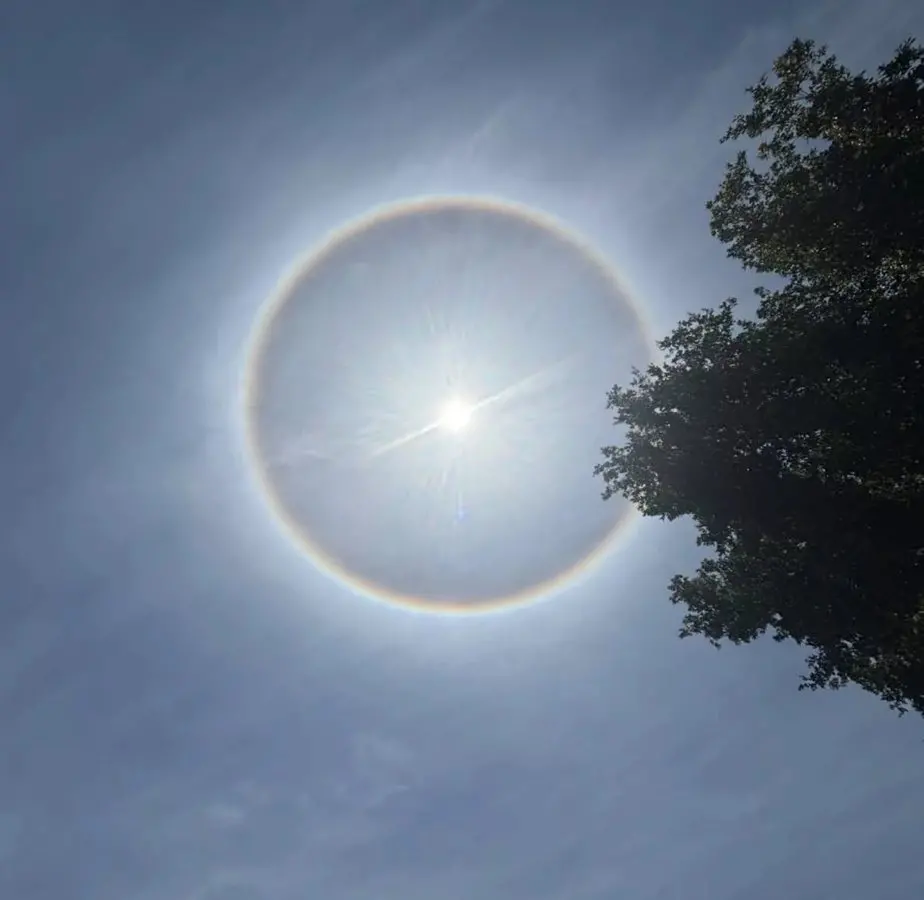
On Monday 16 November, social feeds across South Africa filled with photos of an odd glowing ring encircling the sun, visible over Gauteng and other regions. No, it wasn't aliens or anything wrong with the sun itself. Weather experts quickly identified it as a 22-degree solar halo, a purely optical effect created high above everyone's heads.
Here's how it works: sunlight passes through cirrus or cirrostratus clouds sitting roughly eight to 10 kilometres up, where it's cold enough for ice to exist even on a warm day. Those clouds contain millions of tiny six-sided ice crystals, and as light enters and exits them it bends — refraction — at a consistent angle. That angle is where the name comes from: from the ground, the ring appears about 22 degrees out from the sun.
The halo usually reads as a bright white circle, but look closer and there's often faint colour separation, with reddish tones on the inner edge shifting to blue and violet towards the outside. It's essentially the same physics family as rainbows, just playing out in ice rather than raindrops.
Folk wisdom has long treated sun halos as a rain warning, and there's a grain of truth in it. The high-altitude clouds that produce halos can form ahead of an approaching weather front, so a halo sometimes signals moisture moving in. But meteorologists caution that it's far from a dependable forecast — notably, Gauteng had already been seeing thunderstorms around the time of the sighting, and experts say the halo alone shouldn't be read as a promise of rain.
One practical note if you ever spot one: don't stare at the sun to find it. Direct sunlight can cause serious, permanent eye damage, even when you're trying to frame a photo of the ring. The safer trick is to stand where a building, tree or other object blocks the sun disc itself, letting you see the ring around the obstruction without ever looking straight at the solar disc.
For travellers, this is a nice reminder that some of the best sky shows require no tickets or timing apps — just the right clouds. Halo sightings can happen almost anywhere on Earth where cirrus clouds drift through, so if you notice a pale ring around the sun on a hike or a road trip, shield the sun with your hand or a nearby object and enjoy it safely.