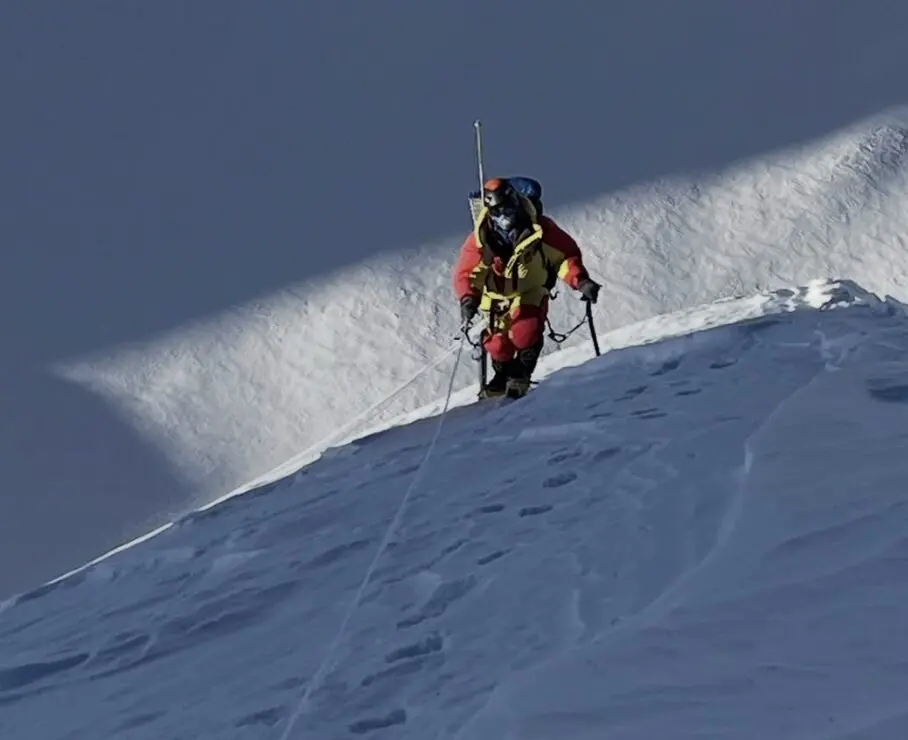
High on Everest's West Ridge, a small Russian team is playing a stubborn waiting game. Sergey Kondrashkin, Vitaly Shiilov and expedition leader Andrei Vasiliev are trying to climb the world's highest mountain without bottled oxygen — and despite being blown off the ridge three times, they have no plans to leave Nepal before winter closes in.
The most recent attempt began on November 11, when the trio set out from their tent at the base of the West Ridge. Forecasts had promised calm conditions, and for a while that held true: the climbers fixed ropes in severe cold, pitched a tent at 6,500 metres, and even managed some rope work higher up. The plan was never to summit on this rotation — Vasiliev admitted they weren't yet acclimatised to go all the way without supplementary oxygen — but they did hope to top their previous high point.
The mountain had other ideas. The next morning the wind arrived in force and never let up. With an even worse forecast looming, Kondrashkin edged back up the ridge between gusts to recover two ice axes and a rope left behind the day before — gear they would need for the descent. The team then packed up their tent, cached food and fuel on the mountain, and downclimbed to Camp 1 at around 5,600 metres, perched on the steep ground between the Khumbu Glacier and the Lho La pass. On Friday they rappelled onto the glacier via what they called a relatively safe route on the right — just as an avalanche swept down nearby.
Their route via the Lho La and West Shoulder is a serious, rarely climbed line, and doing it without oxygen — with no other climbers on the mountain — puts the trio in rarefied company even among elite alpinists. Right now they're regrouping at a lodge in Lobuche, studying forecasts. Vasiliev says the return date is undecided: it all hinges on the weather, and forecasts show high winds hitting around November 20-21.
For most travellers this is a spectator story rather than an itinerary — but it's a vivid reminder of what the Khumbu looks like in late autumn. As the crowds of the October trekking season thin out, lodges in places like Lobuche and Gorak Shep empty, temperatures plummet, and the mountains revert to the domain of a handful of hardened expeditions. Trekkers heading to Everest Base Camp in November get quiet trails and crystal-clear views, but also need to be ready for genuine cold and the same winds that keep these climbers off the summit.
The team's persistence also offers a glimpse of how modern Himalayan climbing works: repeated acclimatisation rotations, gear caches stashed on the route, and constant scrutiny of forecast windows. Whether they get another shot before winter depends entirely on that next break in the jet stream.
ExplorersWeb