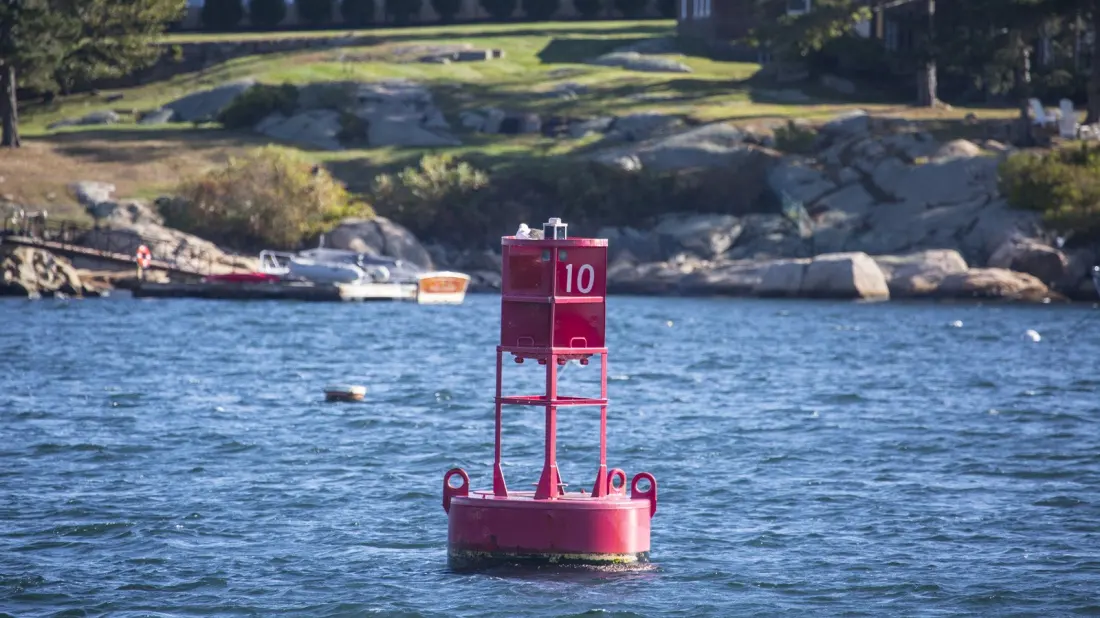
That bright marker bobbing offshore looks like a perfect rest stop mid-swim. Grabbing it might also earn you a $1,500 fine and, more importantly, put you in real danger.
Under U.S. law, touching or tying up to any navigational buoy is off-limits. That covers the red and green channel markers, red-and-green preferred channel buoys, safe water markers, isolated danger buoys and everything else the U.S. Coast Guard installs and maintains. Interfering with these aids to navigation counts as a misdemeanour, punishable by fines of up to $1,500, and the rule applies equally to swimmers, boaters and paddlers.
The safety case is just as strong as the legal one. Navigational buoys are deliberately placed where boat traffic concentrates, so a swimmer pulling up alongside one is sitting squarely in the path of vessels that may never see them. The buoys themselves are hazards too: many are large steel structures anchored to the seabed that roll with the swell, and their surfaces are slick, hard and often crusted with barnacles. Clambering onto one is a reliable way to end a holiday in an emergency room.
There's a subtler trap as well. Some buoys exist purely to warn of danger. A red-and-black-striped buoy on a lake signals a boating hazard below, and whatever endangers a boat is unlikely to be kind to a swimmer. If a marker is warning someone away, treat that as advice worth taking.
Not every float is forbidden, though. Swim area buoys exist to mark designated safe swimming zones, and paddling up to one inside those boundaries is both legal and expected. Private mooring buoys occupy a grey area: touching them isn't against the law, but mooring fields attract steady boat traffic, so they carry similar risks to navigation markers without the fine attached.
Two other colour codes worth knowing before you get in the water. A red-and-white diagonal flag — the classic diver-down marker — means scuba divers are submerged nearby, so keep your distance and watch your fins. And if you're swimming in open water at all, a personal tow float or swim buoy is a cheap piece of kit that makes you visible to boats long before you reach any marker.
The practical takeaway for holidaymakers is simple: use swim area buoys as your touchpoints, bring your own tow float for open water, and leave the navigation markers alone entirely. Coastal and lakeside destinations in the U.S. — think the Great Lakes, Florida's Gulf beaches or the California shore — all follow the same federal rules, so the guidance travels with you. It costs nothing to respect a marker's space, and it saves you a fine, a propeller encounter or a barnacle-scrubbed holiday.
Islands