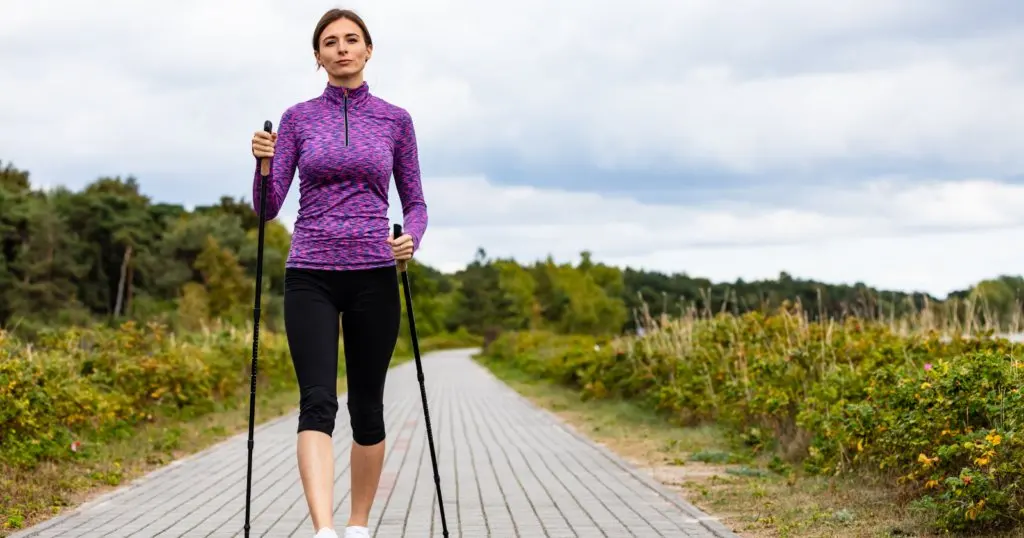
The poles clicking along a city pavement with no snow in sight look like a gentle pastime for older walkers. The backstory says otherwise: Nordic walking began as off-season conditioning for Finland's elite cross-country skiers, with accounts of the practice dating back to the 1930s. Skiers kept their poling rhythm and upper-body fitness alive through the snow-free months by walking with the same poles they used on the trails.
For decades it stayed inside sports institutes — a training drill, not a product. Finnish coach Mauri Repo wrote pole walking into a ski training manual in 1979, but the sport as we know it only took shape in the mid-1990s. In 1996, the Finnish outdoor association Suomen Latu teamed up with the Vierumäki Sports Institute and pole manufacturer Exel, and in 1997 Exel launched the first purpose-built poles alongside a public exercise programme. From Finland it spread fast into Germany, Austria and Switzerland; by the mid-2000s the International Nordic Walking Association counted more than 3.5 million participants worldwide, most of them in Europe.
Why did a ski-team warm-up catch on so widely? Because the poles turn a walk into a whole-body effort. Dr. Aaron Baggish, a cardiologist at Massachusetts General Hospital, told Harvard Health that walking without poles activates muscles below the waist, while adding poles engages the upper body too — he estimates 80 to 90 percent of your muscles, versus roughly 50 percent for ordinary walking. Harvard Health's summary of the evidence puts the extra calorie burn at anywhere from 18 to 67 percent over regular walking, with the well-known 2002 Cooper Institute study landing nearer a 20 percent average increase. Measured trials also show higher heart rates, oxygen use and upper-arm muscle activity compared with plain walking.
That mix explains why older walkers adopted it in such numbers: it delivers genuine cardiovascular work with far less joint pounding than running, which is also why it appears in cardiac rehabilitation programmes. The intensity scales with pace and technique, so a brisk pole walk is a real workout, not a stroll.
For travellers, this is a cheap and portable way to see a new place — and Finland is the natural place to try it. The activity needs no snow, no lift pass and no gym, just poles and a path. Finland's national hiking rights make forest trails and lakeside routes easy to reach from cities like Helsinki and Tampere, where the sport was born. Once you've tried it where it started, you'll never read that sidewalk pole-walker the same way again.
Story via Scandinavia Standard.