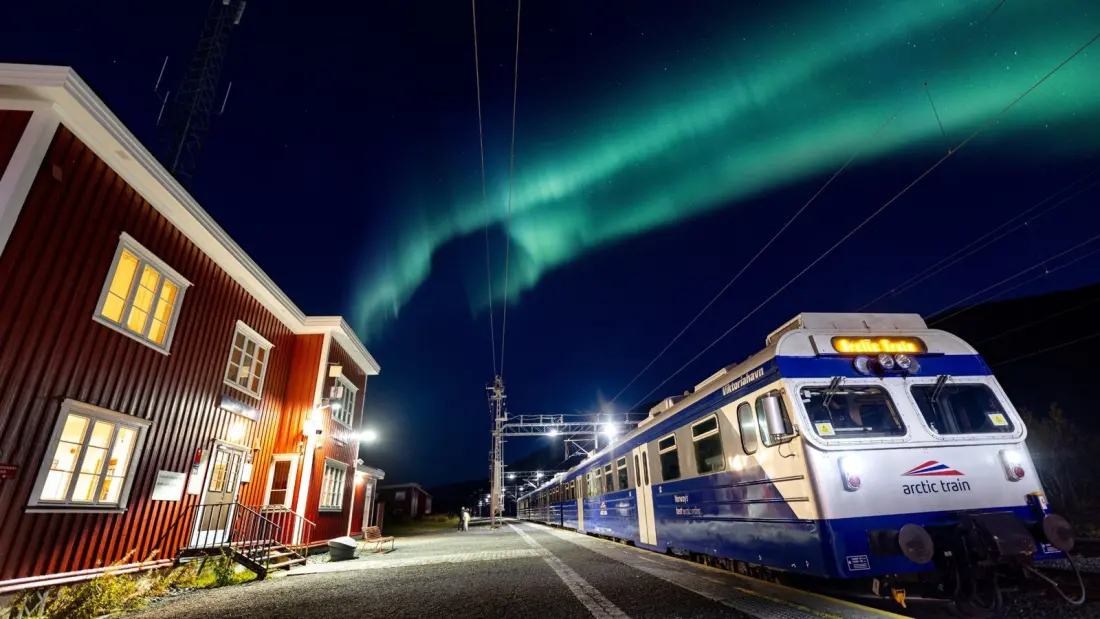
A slick 'aurora train' with glass ceilings and sky-facing recliners flooded social media last winter. The catch: it never existed. The images were AI-generated, and they had nothing to do with the actual Northern Lights Train running in northern Norway since 2022. The real thing is lower-tech — and arguably better.
The genuine article is run by Arctic Train and departs from Narvik, a fjord town about 130 miles north of the Arctic Circle and 144 miles by road from Tromsø. The route follows the Ofoten Line, a historic corridor once used to haul iron ore from Sweden's Kiruna mines to Narvik's ice-free port. Today it carries aurora hunters instead. The trip runs October through March, lasts just over three hours, and climbs into mountains near the Swedish border — terrain you can only reach by rail.
There's no glass roof, but there is a night hike, a campfire with hot drinks and baked goods, storytelling about aurora myths and science, and photography tips from English-speaking guides. The camp sits at Katterat Station, a preserved mountain stop inaccessible by road, with a traditional Sámi lavvu tent to warm up in. Tickets start around $155 (1,495 NOK). General manager Tonny Mathiassen says the area's stable climate and pollution-free dark skies give it high odds of a sighting, though the lights are never guaranteed.
Getting to Narvik is part of the adventure. Fly from Oslo to Harstad/Narvik Airport, Evenes, then drive about an hour. Or go slow: rail from Oslo to Trondheim, the Nordland Line to Bodø across the Polar Circle, then a bus to Narvik — a multi-day trip through fjord country. Once there, the town doubles as a base for ski touring, dog sledding, ice climbing and fat biking. Abisko in Sweden, 90 minutes east, is widely rated among the world's best aurora spots thanks to the auroral oval overhead and its famously clear 'blue hole' of sky.
Timing favours the coming seasons. Solar maximum peaked in October 2024, but solar physicist Pål Brekke of the Norwegian Space Agency notes auroral activity tends to crest a few years after, making 2026–27 promising.
If Norway doesn't fit the itinerary, rail-and-aurora combos exist elsewhere. Finland's Rovaniemi Insider Aurora Train runs roughly four hours through Lapland and will actually stop mid-journey if the lights appear. Sweden's regular sleeper trains to Kiruna and Abisko are a DIY option. In Canada, VIA Rail's Winnipeg–Churchill route delivers you to one of the most reliable aurora towns on the planet, and Alaska Railroad's Aurora Winter Train runs 12 hours from Anchorage to Fairbanks on weekends from mid-September to mid-May, with Denali views on clear days and a decent chance of evening lights before you arrive.
For travellers who want the lights without renting a car or chasing forecasts alone, a guided train like Narvik's is a tidy package: transport, dark skies, a fire, and someone else handling the logistics.