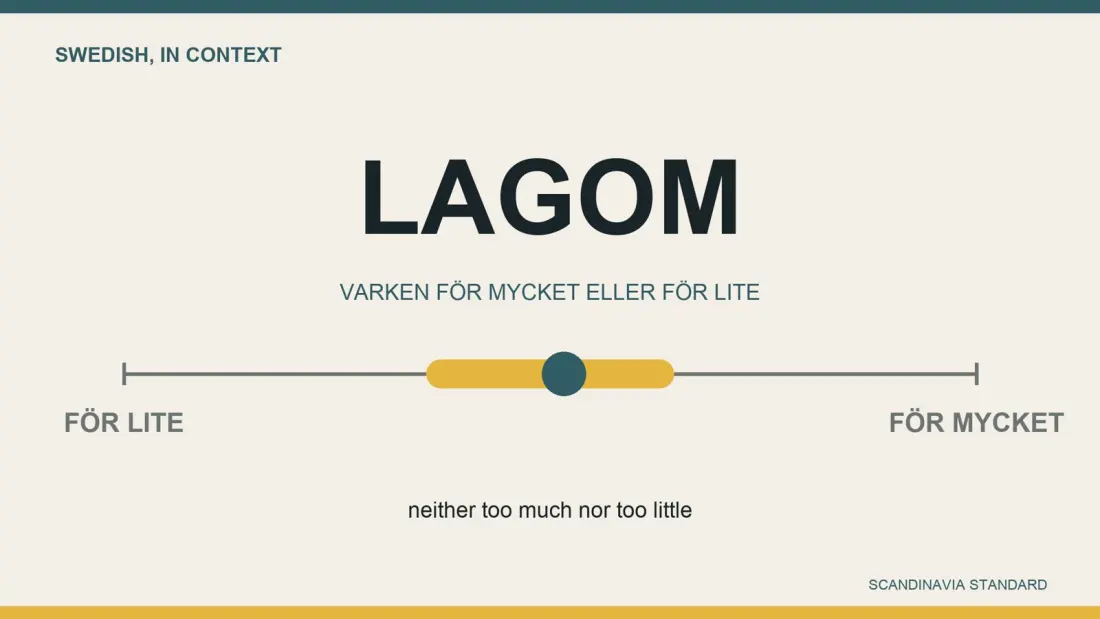
Ask a Swede how their day, their coffee or their flat is, and sooner or later you'll hear one small word doing a lot of work: lagom. It translates roughly as "just right" — not too much, not too little — but the nuance runs deeper than any single English equivalent.
The Swedish Academy's dictionaries define it two ways: as an adverb, doing something to a suitable extent, and as an adjective describing something of a suitable amount. The key word is "suitable". Lagom isn't a fixed quantity or a mathematical midpoint between extremes. It's a judgement in context. A coffee that's lagom strong for one drinker is far too much for another; a coat that's lagom in Malmö might be inadequate in Arctic Kiruna. It can approve generosity or restraint, depending on what the moment calls for.
That's also why "enough" misses the mark. English "enough" often just confirms a minimum has been met — enough fuel, enough money — and "just enough" can sound grudging, even apologetic. Lagom usually carries approval. A lagom walk isn't one cut short; it's exactly as long as everyone wanted. Nothing is missing, and nothing has tipped the balance.
Visitors may encounter the popular origin story: that lagom comes from "laget om", a Viking-age tale of a communal drinking bowl passed around a team, each person taking a fair share. It's a charming image, but the Academy's etymologists trace the word instead to Old Swedish "laghum", linked to "lag" — law or rule — with the original sense of "according to what is proper". Less romantic, better evidence.
In recent years the word has been exported as a lifestyle philosophy, filed alongside hygge as shorthand for moderation: buy less, work sensibly, declutter. There's a real connection, but Swedes mostly use it as a handy everyday adjective, not a national creed. Notably, lagom isn't the same as minimalism — a room full of belongings can still be lagom if everything in it serves the people living there. And tone matters: depending on delivery, "lagom bra" can land as faint praise rather than a compliment, much like a suspiciously flat English "fine".
Why should a traveller care? Because understanding lagom is a shortcut to understanding Swedish culture — the dining tables, the design shops, the unhurried fika breaks, the general resistance to excess and ostentation. You'll hear it in cafés and read it on menus. And there's a practical bonus: rather than hunting for "authentic" extremes, the lagom approach to travel is its own reward. Eat the portion that suits your appetite, walk the distance that feels right, and skip the pressure to maximise every itinerary. Sweden is a good place to practise.
For the full linguistic deep-dive, including the grammatical flexibility that makes the word so useful, the original explainer is worth a read.