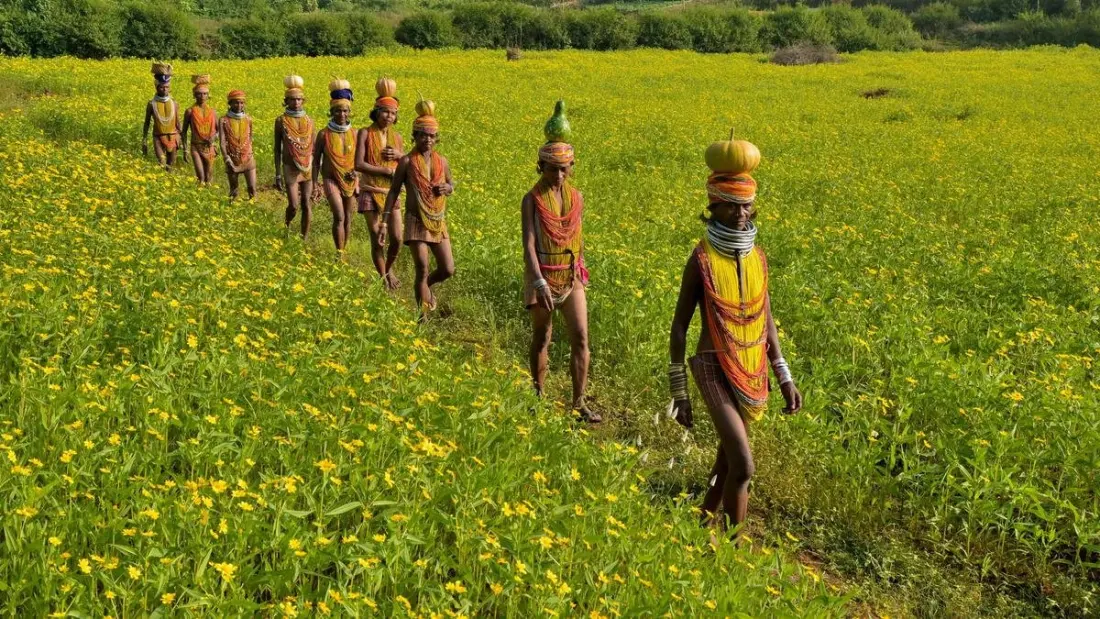
In the Bonda Hills of Odisha's Malkangiri district, a striped handwoven skirt called the Ringa remains the visual signature of one of India's most distinct communities. Worn by Bonda women as a wraparound, it carries bold horizontal bands of red, maroon, black, white and blue — and, according to the women who make it, a family's story in every thread.
The Bondas are one of India's Particularly Vulnerable Tribal Groups, and anthropologists think they may descend from one of the earliest waves of humans to leave Africa some 60,000 years ago. Their language, Remo, and their customs have survived remarkably intact, and women sit at the centre of community life: farming, trading at the weekly Thursday market in Onukudelli, and passing weaving skills mother-to-daughter, with grandmothers quietly correcting technique until it becomes muscle memory.
What sets this tradition apart is that it was never about commerce. The original Ringa was woven from fibre of the Kerang, a wild shrub of the Eastern Ghats; cotton yarn later took over, but the look barely changed. A single cloth takes two to three days, fitted around farming and household work, and was traditionally made only for family and community use — one of the few Indian textiles where one garment has anchored an entire people's identity for generations. The tight weave reflects its role as everyday clothing, not ceremony.
That is slowly shifting. Textile scholars, collectors and travellers now buy Ringas directly from weavers, who earn a modest supplement as buyers turn the cloth into framed art, wall hangings or table runners. Textile engineer Navaldeep Thareja, who documents little-known craft clusters through his initiative Behrupiaa Arts, runs small curated textile tours to Malkangiri — with strict etiquette: pre-visit briefings on local customs and photography, and no village treated as an attraction. Weavers who want to engage bring their work to locally run homestays rather than opening their homes, so participation stays entirely on their terms.
The craft faces real pressure. Weaving alone doesn't pay the bills, ready-made clothes are everywhere, and fewer young women are learning as education and other jobs pull them away. Yet the Ringa still matters most at festivals, when families dress in traditional attire — and every purchase from a visitor, weavers say, is encouragement to keep the loom going.
For travellers, this is a chance to see a living textile tradition at its source rather than in a city emporium. Time a visit around a Thursday to see the Onukudelli market, where Bonda women arrive in layered bead necklaces, aluminium neck rings and blue shawls over their Ringas. The most rewarding way in is a responsible, small-group textile tour with proper local briefings — buying directly from artisans does more good than any souvenir shop.