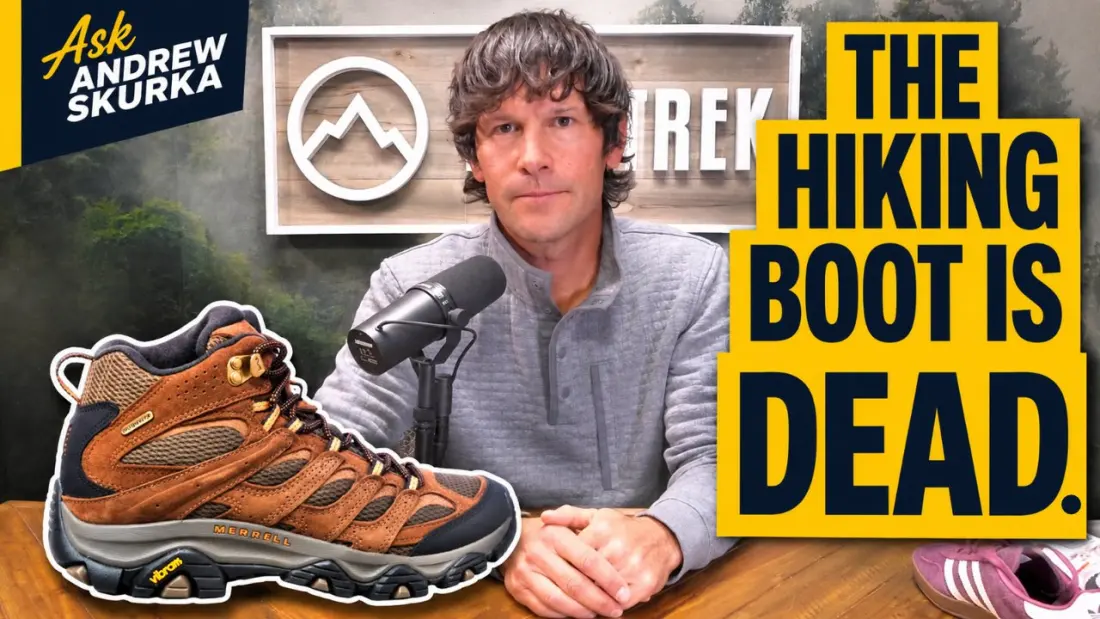
Boots have long been sold as the default backpacking shoe. Andrew Skurka, the thru-hiking legend behind first traverses of the Great Western Loop, the Alaska-Yukon Expedition and the Sea-to-Sea Route, thinks that's wrong. In a recent video series with The Trek, the veteran guide — who has spent 17 years leading trips in southern Utah, the High Sierra, Alaska and Yellowstone — argues that cutting-edge backpackers overwhelmingly wear trail runners, not boots. His point isn't that boots are bad, but that most hiking footwear isn't actually designed for backpacking at all. Trail runners just happen to be the closest thing that works.
His core argument borrows from other sports. Serious skiers and cyclists own a quiver — a cross-country ski, a skate ski, an alpine setup, each built for a purpose. Runners do the same: a grippy trail shoe with a narrow fit, a plush road shoe with thick foam, a featherweight racer. Backpacking footwear, he says, rarely gets that same application-first thinking. Instead of hunting for 'the best hiking boot of 2026', you should ask what conditions you'll actually face.
The practical advice breaks a shoe into three parts. Outsoles trade sticky rubber against durable rubber, and lug depth matters: tall lugs with shorter edges grip mud, snow and sand, while flatter, smoother soles suit hard-packed trails and slickrock scrambling, where approach-style flat rubber gives more contact area. Midsoles (the foam, measured as stack height) pose a cushion-versus-stability trade-off — taller stacks like a plush HOKA absorb blows but feel wobblier, while firm foam in something like a La Sportiva offers better ground feel. Uppers are usually the first thing to fail, so durability matters for long trips, alongside breathability versus waterproofing.
Terrain should drive the pick. On flat, benched trails like the John Muir Trail, a wide-fitting shoe such as the popular Altra Lone Peak works well — though Skurka admits they feel like clown shoes on him. Off-trail in steep mountain country, a narrow last like the La Sportiva Bushido gives lateral stability; the even tighter TX Guide suits technical terrain but punishes long days.
Why does a gear debate matter to holidaymakers? Because sore feet can sink a walking trip faster than bad weather. If you're planning a trek in Utah's canyon country, the Sierra, or on a long-distance trail, it's worth matching your shoes to the ground underfoot rather than buying whatever looks sturdiest on the shelf — and trying them on with your own socks and an overnight pack. Skurka's 2027 guided trips open for applications on 7 December, if you'd rather learn this stuff with a guide along.
The Trek