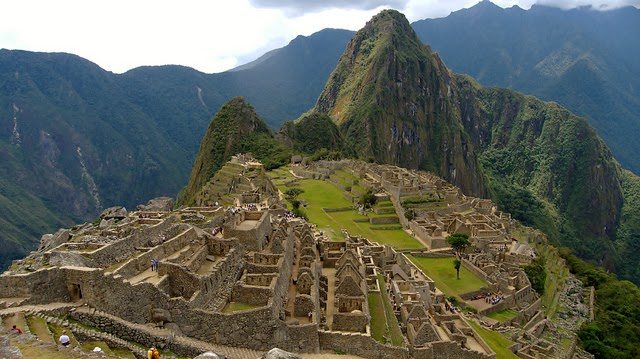
Everyone knows the classic Machu Picchu shot: the green citadel perched on its mountain ridge with Huayna Picchu looming behind. But a closer look at the site reveals a place far stranger and more interesting than the postcard suggests — and knowing a few of these details changes what you actually see when you get there.
Start with the stonework. The famous walls are dry stone: no mortar at all. Each block was carved for its specific spot, interlocking with its neighbours so that compression alone holds the whole thing together. Up close the joints look almost random, but that irregularity is deliberate — a craft tradition, not sloppy work. It is also why the buildings, dating to around 1450, look remarkably pristine despite nearly 600 years of mountain weather.
Then there is the mystery of why the site emptied out. Contrary to popular belief, the Spanish probably never set foot in it — no written record mentions them there, and the conquistadors left their mark on sacred rocks almost everywhere else they went. The site was deserted by 1572, most likely because smallpox, travelling ahead of the invaders, wiped out the population. There is a second reason it faded from memory: Machu Picchu was never really a city. It is thought to have been a private estate built for Pachacuti, the ninth Sapa Inca — essentially a royal mountain retreat, aligned with cosmological events that mattered to the Inca.
Even the "lost city" story is muddled. When Hiram Bingham announced his discovery to the world in 1911, people were still living there — a local Quechua boy led him to the ruins. Bingham's habit of shipping artefacts abroad did not win him friends in Peru.
The terraces deserve more than a passing glance too. They fed the estate, and archaeologists think they may have doubled as an agricultural laboratory: test plots in different micro-climates to work out which crops would thrive across the Inca Empire. They also drained the slopes, prevented landslides and — cleverly — steepened the approaches, making any assault on the citadel far harder.
Why does any of this matter to a visitor? Because the site rewards attention as much as spectacle. Walk up to the walls and study the joints. Look down at the trail winding up the mountainside to grasp the sheer scale of the labour. And stand where the Inca stood at dawn, looking outward from the estate rather than at it — the view that greeted its residents every morning. Machu Picchu is not as flat or as small as photos imply, and arriving with this context turns a crowded bucket-list stop into something genuinely absorbing.
If you are planning the trip, build in time beyond the standard two-hour circuit: the terraces, the Temple of the Sun's stonework and the outward views all repay a slower pace.