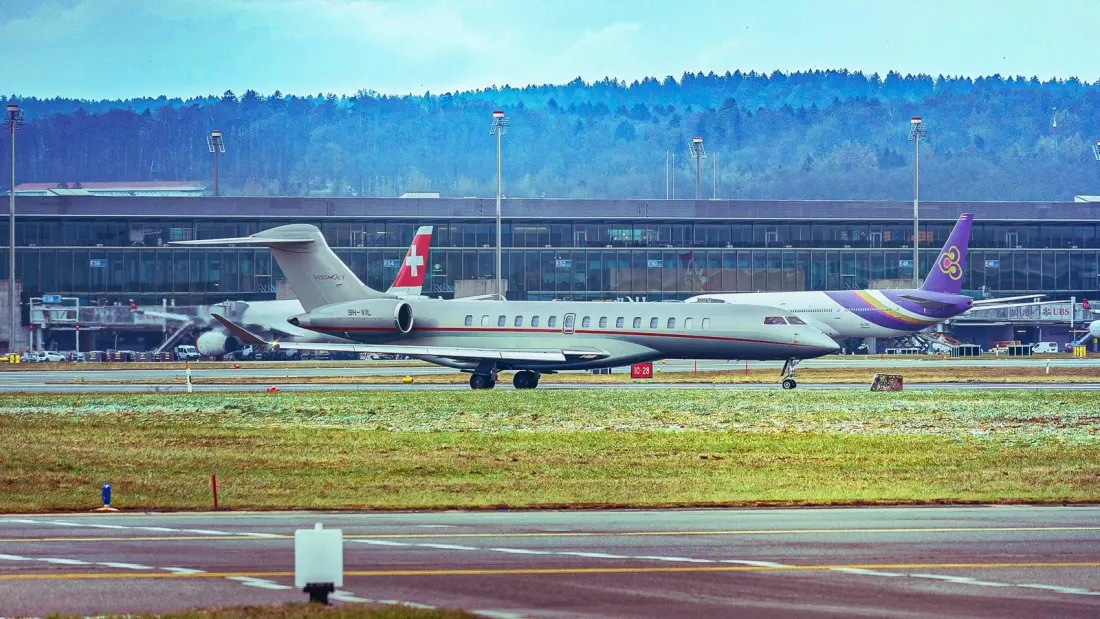
A single business jet hopped between Europe, North America and South America in under a week, and the flight log reads like an itinerary most airline passengers could only dream of booking. Between October 9 and 15, Simple Flying tracked a VistaJet-operated Bombardier Global 7500/8000 (registration 9H-VIL) to see just how far one ultra-long-range aircraft can travel when its schedule answers only to paying customers.
The opening day set the tone. The jet left Paris-Le Bourget at 05:13 UTC, touched down at Rome Ciampino 93 minutes later, then launched into a 10-hour, 21-minute nonstop crossing to Leesburg, Virginia — the low-key executive airport near Washington, DC. Barely 90 minutes after landing, it was airborne again for the short hop to Miami. Three flights, three countries, one day.
From there the aircraft worked south. It flew Miami to Buenos Aires nonstop in eight-plus hours on October 10, then the next day made a same-day round trip to Calama in northern Chile — the gateway to the Atacama Desert, a destination with virtually no nonstop commercial network. The week continued with sectors to Brasília, back to Miami overnight, and finally up to Bedford, Massachusetts. Nine flights across four countries, with nothing as mundane as a connection or a gate change.
The aircraft itself explains the range. The Global 7500 is rated for 7,700 nautical miles; the newer Global 8000 stretches that to 8,000 with a top speed of Mach 0.95. Confusingly, databases couldn't agree which variant 9H-VIL is — because Bombardier now sells a conversion package upgrading 7500s to the 8000 standard. VistaJet says it has already converted 12 of its 18 Globals and expects the full international fleet done by the end of the year.
So who gets to travel like this, without owning a jet? VistaJet runs a subscription model. Its VJ25 program, for instance, sells 25 to 49 flight hours a year over a three-year term at a fixed hourly rate per guaranteed flying day. Ownership costs — crew, hangarage, insurance, maintenance, training — stay with the operator. One customer doesn't follow the aircraft around; the jet simply moves wherever booked demand takes it, more like a ride-hailing fleet than an airline route map.
None of this makes private flying cheap. Fuel, handling, navigation fees and crew costs scale with every leg, and published range figures are planning benchmarks rather than guarantees — winds, payload and routing all bite into them. For curious travellers, the practical takeaway is that empty-leg deals are the realistic entry point: discounted repositioning flights on routes the jet was flying anyway. For everyone else, the week's log is a neat illustration of why business aviation exists at all — time and access to airports commercial airlines simply don't serve.