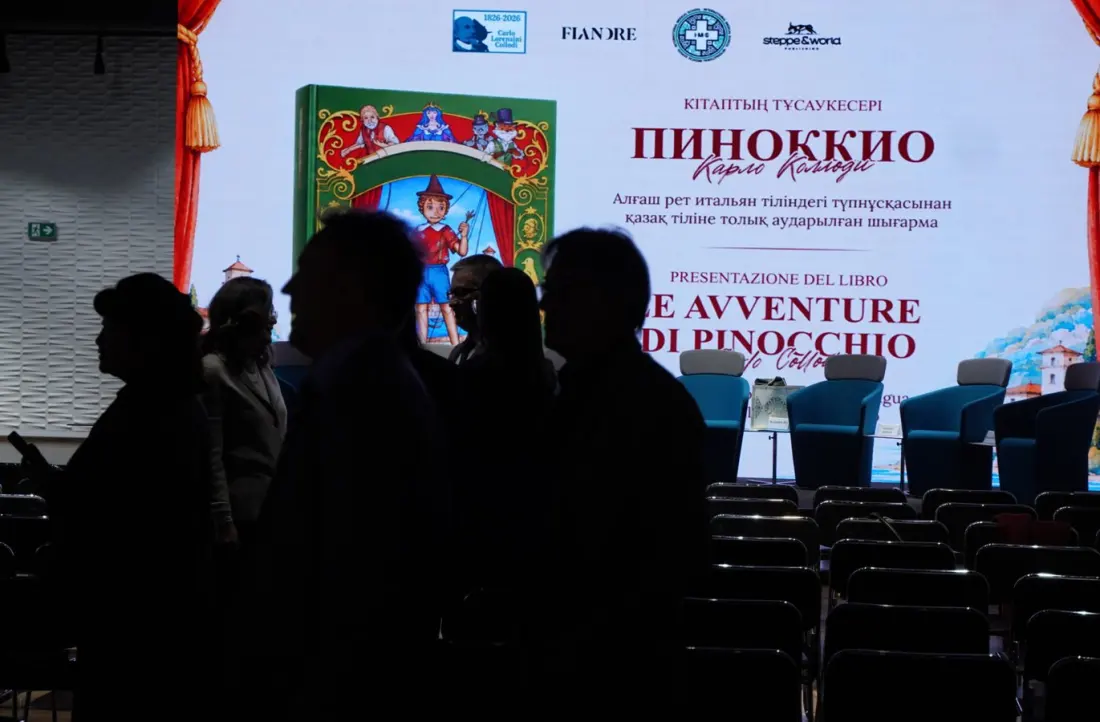
Carlo Collodi's 'The Adventures of Pinocchio' has finally landed in Kazakh. The first complete translation made directly from the original Italian was unveiled in Astana on 12 November, marking a milestone for both Kazakh-language publishing and cultural ties between Italy and Kazakhstan.
The project was timed to the 200th anniversary of Collodi's birth, and it comes with a distinctly local visual identity. Kazakh illustrator Sultanbek Aitzhanov won an open competition that drew 75 entries from 19 cities across the country, then spent nearly six months on the artwork. A study trip to Bologna — including the city's famous children's book fair and a wander through theatrical supply shops — shaped his approach to the characters.
Beyond the celebration, the translation signals something bigger for Kazakhstan's literary scene. Until recently, much foreign literature reached Kazakh readers via Russian-language intermediary versions. Translating straight from the source language, as the Union of Writers of Kazakhstan points out, is a newer possibility for the country's younger generations.
For travellers with an interest in books and culture, the story offers a nice entry point into Astana's growing cultural calendar and into Italy-Kazakhstan exchange more broadly. Italian writer and historian Giordano Bruno Guerri, who chairs the committee behind the Collodi bicentenary, hopes the edition opens the door to more two-way translation — Italian works into Kazakh, Kazakh works into Italian — and plans to present the book in Italy and at a major fair in Mexico. Italian Ambassador Antonello De Riu framed it as a way of bringing the two countries' cultures closer together.
Why does a 19th-century Italian puppet story still travel so well? According to Guerri, its characters work as everyday moral lessons: the Talking Cricket stands for conscience, while the Cat and the Fox embody the pull of money and power. Children take the adventure at face value; adults read it as a story about mistakes and responsibility. That dual appeal is exactly why the book keeps being reinterpreted in new languages and settings.
If you're passing through Astana, this is a good excuse to browse local bookshops and keep an eye out for translation-related events — and to pair it with the city's striking modern architecture, which makes it one of Central Asia's most interesting capital breaks.