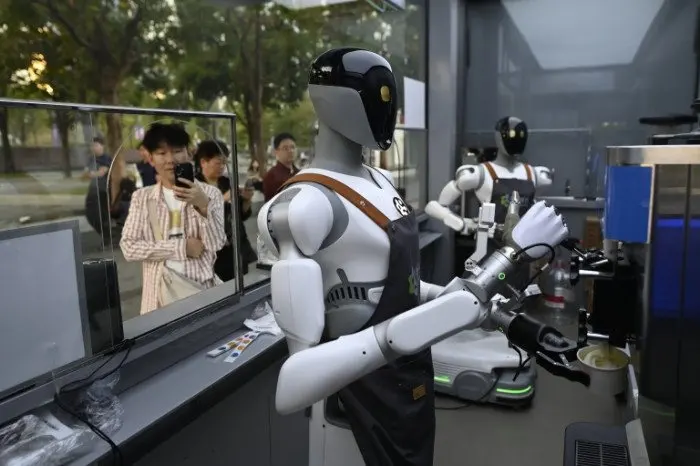
At a refreshment stand in a Shenzhen park, a humanoid robot squirts out a soft-serve spiral and hands it over, while its robo-barista colleague pours coffees — around US$4 a cup, with up to 300 sold daily. The machines, made by startup AI² Robotics, are part of a showcase the city put on as world leaders including Donald Trump and Vladimir Putin arrived for the Apec summit.
The park pair still need human help — someone has to refill the coffee beans and empty the grounds — but their movements are driven by an AI model, and the company says 200 of its robot servers are already working across China. CEO Guo Yandong says the constant stream of real-world feedback, from changing light conditions to unpredictable customers, is what trains the machines to cope outside the lab.
That training depends heavily on people. In a supermarket in nearby Dongguan, a 23-year-old worker wears sensor gloves and a camera helmet while stocking shelves, her movements captured by startup Strange Attractor, which resells the data to firms building AI 'brains' for robots. Cobblers, hairdressers, florists, cleaners and factory workers across China are doing the same for pay. Strange Attractor collects data in roughly 1,600 locations in China and 1,000 abroad.
Why Shenzhen? The city of 18 million, just north of Hong Kong, is a manufacturing powerhouse with dense supply chains for motors, sensors and batteries. Experts say that lets developers prototype, test and deploy parts faster than almost anywhere else — a key reason China dominates this space. Tax data shows industrial spending on 'embodied AI' robots jumped 230% year-on-year between January and May 2026, and an Ipsos survey found 83% of Chinese respondents excited about AI products, far above the one-in-three Americans who said the same.
There are limits, though. At a Shenzhen logistics centre, X Square Robot's dual robotic arms deftly flip parcels label-up on a conveyor — but teaching machines to handle messy, variable home environments remains much harder. One specialist compares today's robots to babies: capable in repetitive, well-defined tasks like plugging high-voltage connectors at battery giant CATL, but a long way from general-purpose helpers. Still, Strange Attractor's founder predicts 'massive deployment' next year, with strawberry picking and basic housework among early uses.
For travellers, Shenzhen itself is the draw. The city has quietly become a place where you can watch this future in action — robots serving ice cream in a public park, robotic arms sorting parcels — often for the price of a coffee. Anyone combining Hong Kong with a mainland China visa run or a tech-curious side trip will find plenty to see.