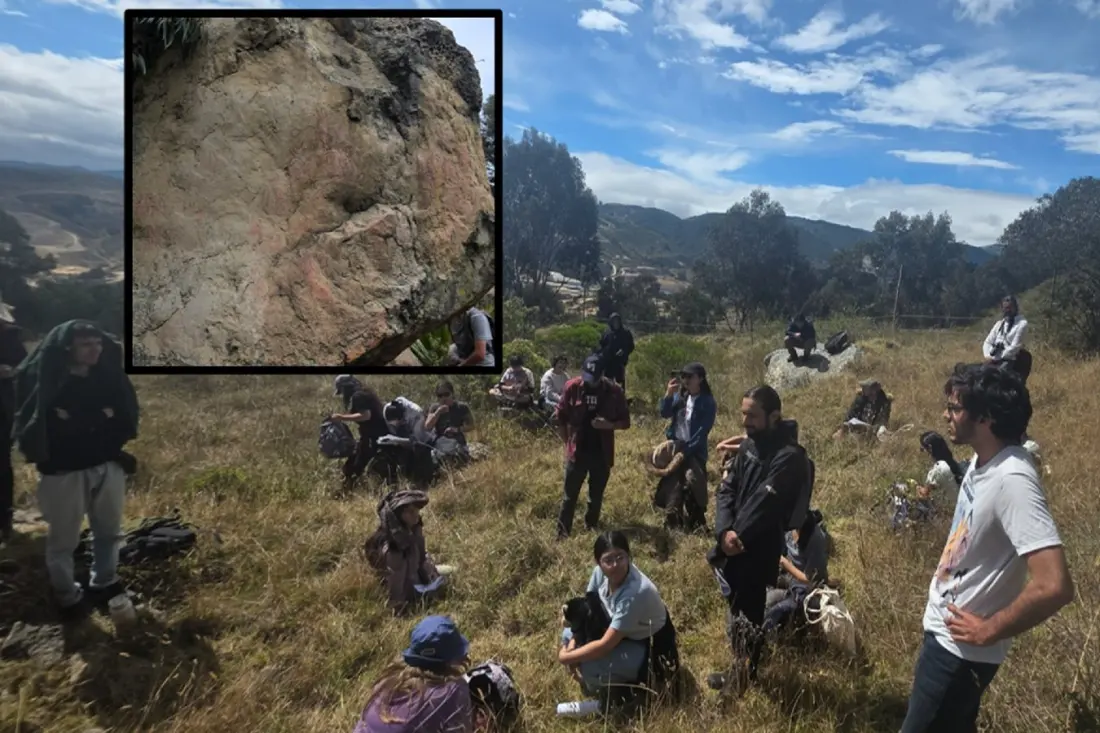
On the southern edge of Colombia's capital, some of the country's oldest artworks are painted straight onto rock faces — and they're slowly disappearing. Between April and September 2026, Colombia's Institute of Anthropology and History (ICANH) ran a programme called the Dialogues for the Recognition and Protection of Rock Art Sites in Soacha, a sprawling municipality just south of Bogota, to train local residents in identifying and safeguarding these pre-Columbian pictograms and petroglyphs.
The threats are both natural and human. Rainfall and water seepage degrade the rock shelters and the ancient pigments themselves, while fires and humidity take their own toll. But people cause plenty of damage too. A surprisingly common practice among curious visitors is wetting the rock to make faded colours pop — which seeps into the surface, weakens the pigment and effectively erases figures that have survived for centuries. Others have scrawled graffiti over the art or covered panels in paint and enamel.
The programme unfolded in four phases mixing online sessions, hands-on workshops and field visits. Participants learned basic conservation principles, joined a practical workshop called "Following the Traces of Color," and walked the San Mateo petroglyphs in Soacha's most densely populated district to assess conditions on the ground. A second field trip went to the Varón del Sol, a pre-Columbian figure carved and painted on a boulder in the rural Fusunga district — a landmark so tied to local identity it's said to have given the municipality its name. Each visit fed into a participatory diagnosis, and the process wrapped up with residents drafting their own conservation proposals.
The logic behind the effort is simple: when a rock painting is destroyed, more than an image is lost. The archaeological context goes with it, along with clues future researchers might need to answer questions we haven't thought to ask yet. Photographs can't fill that gap. ICANH's framing is that heritage isn't just the object on the rock — it's the knowledge it holds and the link it creates between a community and its territory.
For travellers, this is a nudge to treat urban-edge archaeology with the same care you'd give a famous site. Soacha is easy to reach from Bogota, and sites like the Varón del Sol offer a rare chance to see pre-Columbian rock art without heading deep into the countryside. The etiquette is straightforward: never touch the surface, never apply water to enhance the colours, keep to designated paths, and leave no marks. If you're keen on rock art more broadly, Colombia has far richer concentrations in places like Serranía de La Lindosa in Guaviare — but the sites around Bogota are a reminder that heritage often hides in a city's own backyard.
Community stewardship is increasingly what keeps fragile sites alive, and Soacha's residents now have the training to spot problems early and act on them. Visitors who follow their lead are part of that story rather than a threat to it.