There are odd museums, and then there's Transnistria's Bottle Museum — a building in the village of Ternovka shaped like a giant bottle, 28 metres tall, filled floor to floor with roughly 10,000 bottles of alcohol from more than 100 countries. It sits a short drive from Tiraspol, the capital of the breakaway territory that declared independence from Moldova in the early 1990s and now runs its own government, currency and armed forces despite being internationally recognised as Moldovan soil.
The collection began with one man: Grigory Korzun, a local entrepreneur linked to the Tiligul Tiraspol football club, who received a bottle of champagne from a friend in 1988 and never really stopped. His hobby outgrew his basement, so he built a bottle-shaped museum — completed in 1998, opened to the public in 2003. After his death, his son Stanislav took over, making it a genuine family-run operation. Note the numbers game: local reports cite around 10,000 bottles from 100-plus countries, while Moldova's official tourism site claims over 20,000 from 170 countries. Either way, it's a lot of glass.
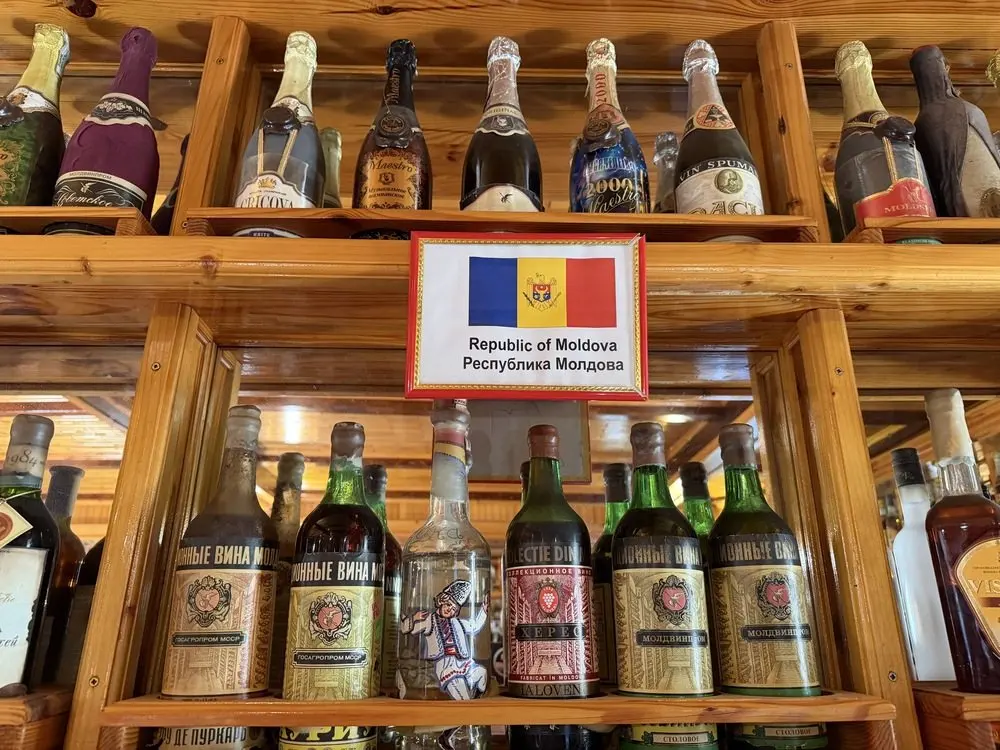
The exhibits range from the sublime to the ridiculous. There's vodka shaped like a full-size Kalashnikov in a wooden case, a container modelled on the Moscow Kremlin, bottles disguised as books (a Polish piece hiding śliwowica plum spirit inside a Pan Tadeusz cover), a Mexican miniature shaped like a bullet holding just 10 grams, and a 25-litre Ukrainian bottle stopped with a corn cob. Chinese infusions contain preserved snakes and a lizard suspended in rice alcohol. On the historical side, highlights include mead dated 1882, reportedly dug up during excavations in the Slobodzeya district, KVINT's 50-year-old Prince Wittgenstein cognac, a 12-litre bottle made for the 1994 FIFA World Cup, and shelves of Soviet-era wines and champagnes no longer produced. There are even North Korean bottles — a surreal crossover between two diplomatically isolated places, whose route to Ternovka remains undocumented.
Is it worth a detour? If you expect academic curation, temper your expectations — this is a private collection driven by one man's obsession, heavy on individual objects rather than structured history. But that's exactly its charm. It doubles as an accidental archive of Soviet consumer culture, commemorative manufacturing, branding and the post-1991 entrepreneurial boom in a territory undergoing upheaval.
Practically, visits are usually arranged by appointment at 22 Kotovskogo Street, Ternovka, so confirm access and any tasting programme in advance rather than turning up cold. Pair it with Tiraspol's KVINT distillery, founded in 1897 — KVINT shows you how the drinks are made, while the Bottle Museum shows how creative people get about containing them. Add Bendery's fortress and the region's Soviet monuments for a full trip to Europe's least-recognised corner. For anyone who collects strange bottles, the Korzun family is the proof of what happens when you never throw one away.