One writer flew from Colorado to Winnipeg for a single reason: to see Propagandhi, the politically charged punk band that came out of the Manitoba prairie in the 1990s and has spent three decades shouting about workers' rights and animal advocacy. The trip turned into a deeper question — how does a city 500 miles from the nearest major metropolis (Minneapolis) keep producing such fired-up music?
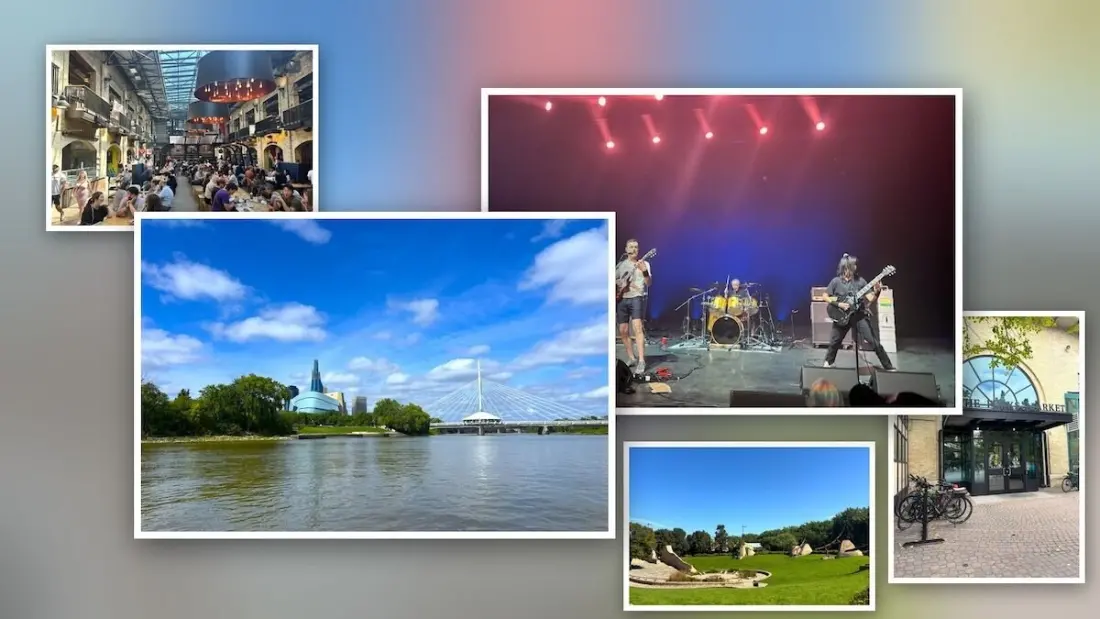
The answer starts with history. The 1919 Winnipeg General Strike, which shut the city down for six weeks over wages and working conditions and left two protesters dead, still shapes Winnipeg's self-image as a blue-collar town. That legacy is front and centre at the Canadian Museum for Human Rights, the striking glass-and-stone building whose exhibits cover everything from the 1919 strike to the LGBT Purge of the late 20th century, including Michelle Douglas's landmark 1992 legal challenge that ended the military's discriminatory policies.
Winnipeg sits where the Assiniboine and Red rivers meet, a gathering place for Indigenous peoples for more than 6,000 years. Today that confluence is The Forks, a 52-acre public space anchored by a granite monument to Missing and Murdered Indigenous Women, Girls, and Two-Spirit people. It's also home to The Forks Market, where you can grab a falafel from Zorba's, a local craft pint at The Common, and hear five languages in one dining hall — fitting for a city with the largest Indigenous population of any major Canadian city plus a substantial South Asian community.
That mix fed the music. Winnipeg once ran a thriving Ukrainian music industry for Western Canada, and the immigrant "social" — 500 people packed into a curling rink with a band — launched acts like Harlequin and Streetheart in the 70s through 90s. Music historian John Einarson, who leads tours of the city, argues it wasn't politics but geography that defined the sound: an "us against the world" mentality beyond the Perimeter highway, and a "fly-over city" that big touring acts skipped, creating fierce loyalty to local artists. Neil Young learned his trade here before writing "Ohio," and The Weakerthans — fronted by former Propagandhi bassist John K. Samson — carry the same mission-driven ethos at lower volume.
The show itself happened at the Burton Cummings Theatre, with opener Op-Ed, a protest rock band formed in late 2023 by Palestinian-Canadian refugee Tarek Abdel Aziz. And there's a ready-made excuse to go: JUNO Week lands in Winnipeg April 1–4, 2027, the city's third time hosting. For a nightcap, Einarson recommends the Times Change(d) High and Lonesome Club on Main Street for roots music and a funky room.
For travellers, Winnipeg is more than a punk pilgrimage. It's a prairie capital where labour history, Indigenous reconciliation and a genuinely sturdy music scene intersect — best understood on foot at The Forks, by boat on a Winnipeg Waterways tour, and loudly, in a theatre full of locals who never needed the coasts to make noise.
Story via Matador Network.