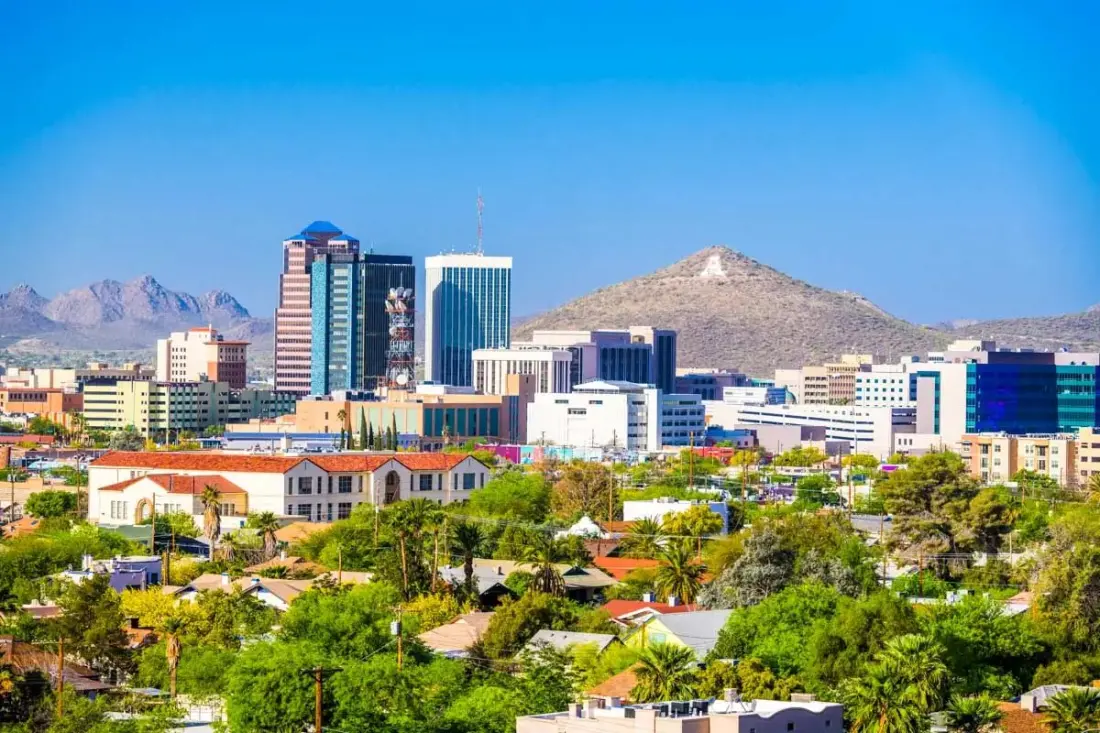
Tucson doesn't do things by halves. The city sits in the middle of the Sonoran Desert, ringed by mountains and giant saguaro cacti, and the best experiences here mix that wild scenery with a genuinely serious food culture — Tucson was the first US city designated a UNESCO City of Gastronomy, and the local Southwestern flavours show it.
The standout activity, according to Destinationless Travel, is an e-bike tour of Saguaro National Park. The 2.5-hour ride follows the park's paved eight-mile loop past forests of saguaros, with the electric assist taking the pain out of the hills. Guides brief you on safety and the desert ecosystem, and groups stay small. You need to be comfortable on a regular bike, and there's next to no shade — water, sunscreen and a hat are non-negotiable.
If you'd rather be in the saddle than on one, a 90-minute horseback ride through Catalina State Park and Coronado National Forest serves up sweeping views of the Santa Catalina Mountains. It sells out weeks ahead, so book early. Hikers have plenty of free options too: Saguaro's two districts, Sabino Canyon and Catalina State Park all offer desert trails, best tackled early in the morning with far more water than seems reasonable.
Tucson's museums punch well above their weight. The Pima Air & Space Museum spreads more than 400 aircraft across six hangars and 80 acres of outdoor display, spanning a Wright Flyer replica to a Boeing 787. The Arizona-Sonora Desert Museum is harder to classify — part zoo, botanical garden, aquarium, art gallery and natural history museum, with 230 animal species and 1,200 plant types across 98 acres. Plan for half a day, not a couple of hours.
For a city fix, a food tour through downtown covers six tastings over four hours — the tamales get special mention — while doubling as a walking history of spots like Hotel Congress and the Fox Tucson Theatre. A two-hour bike tour loops through Barrio Viejo's colourful adobe streets, past St Augustine Cathedral and the Pima County Courthouse, and through the Rattlesnake Bridge, which is exactly what it sounds like: a giant diamondback rattlesnake you cycle into through its open mouth. Finish with the drive up Mount Lemmon, where the landscape shifts dramatically as you climb into cooler air — a guided four-hour tour lets you actually look at the views instead of the winding road.
Practical notes: Tucson is spread out, so a rental car makes life much easier, especially for the parks and mountains. Temperatures swing hard between day and night, so pack layers. And between mid-June and September, monsoon storms can roll in fast — check the forecast before any outdoor plans.
A suggested three-day shape: day one for the botanical gardens, a food tour and Barrio Viejo; day two for a museum plus the Saguaro e-bike ride; day three for horseback riding, the Desert Museum and some stargazing to close it out.
This story is based on Destinationless Travel.