For much of Australia's colonial history, having a convict in the family tree was the sort of thing families quietly buried. Today it's a claim people make with pride — and the journey from one to the other says a lot about how the country sees itself.
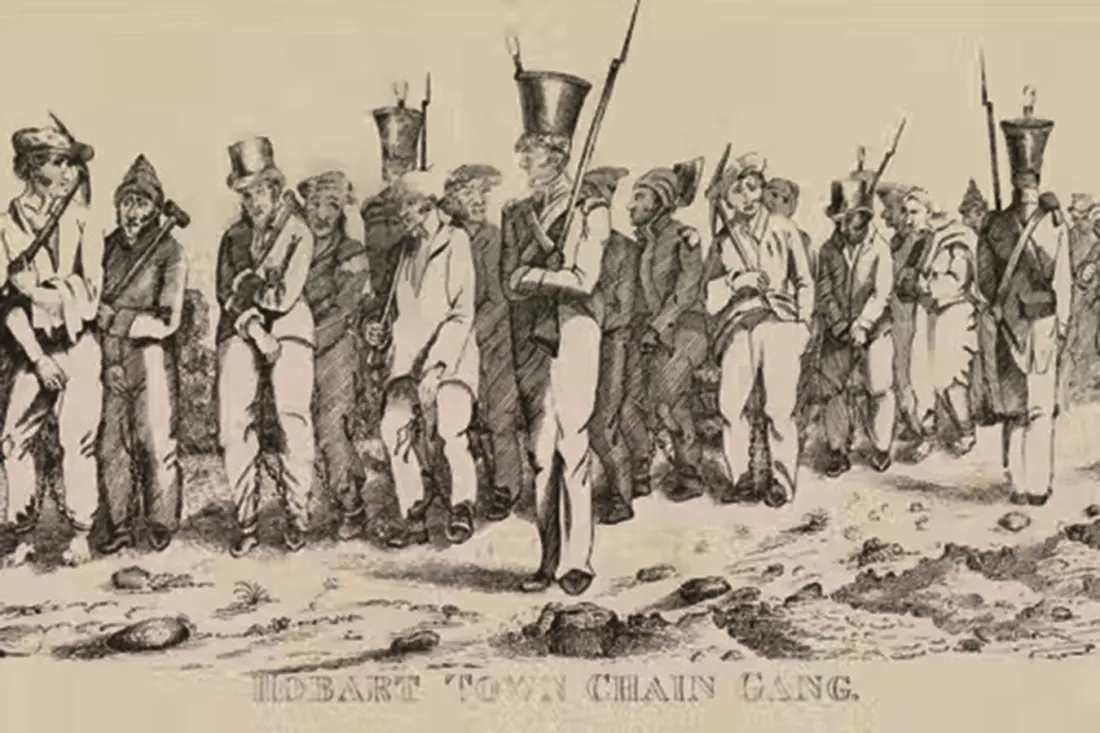
Between 1788 and 1868, roughly 162,000 convicts were shipped to Australian penal colonies, many to New South Wales and Van Diemen's Land — the latter so notorious it was dubbed "the dunghill of England". When transportation there ended in 1853, the colony rebranded itself as Tasmania, explicitly to shake off the association with "bondage and guilt". Ex-convicts often changed their own names too. Edwin Rose, a Parkhurst boy jailed for stealing two loaves of bread, was exiled to New Zealand and later sent on to Van Diemen's Land; he resurfaced in Victoria as William Williams before being shot dead in 1863 while stealing a pig.
Others managed a cleaner reinvention. Henry Butler Dowie, another former Parkhurst prisoner, opened a shop in Evandale, Tasmania, and won a seat on its first municipal council in 1865. By his death in 1889, his convict past had been airbrushed into a story about emigrating during the gold rush. Historian Alison Alexander notes convicts became so adept at rewriting their pasts that by the 1920s most descendants had no idea.
Attitudes shifted slowly. The 1920s already showed selective sympathy — Irish Catholic convicts were praised for their "gallantry and independence". Then the 1960s brought social history into the mainstream, with books like Alan Shaw's Convicts and the Colonies recasting convicts as ordinary people whose lives mattered. The real turning point was the 1988 bicentenary: where convict ancestry had been a cause for shame a century earlier, Australians were now openly proud of it.
That pride has since been institutionalised. Key convict sites across New South Wales, Tasmania, Norfolk Island and Western Australia earned UNESCO World Heritage listing in 2010, and the associated records joined UNESCO's Memory of the World register. Cheap DNA tests and digitised archives have turned the interest into a boom: when the University of Tasmania launched its online Convict Ancestors course in 2016, more than 1,000 students signed up.
The article's author, historian Kristyn Harman, offers a striking personal example. A DNA test revealed her family's cherished Maclachlan clan lineage was wrong — her real ancestor was Samuel Landon-Lane, a 19-year-old Hereford sawyer transported to Western Australia in 1850 for burglary, who did time in Fremantle Prison and later worked the WA goldfields.
For travellers, this history is now the destination. Fremantle Prison, Port Arthur, the Norfolk Island settlements and Sydney's convict-era buildings are World Heritage attractions with rich interpretation, and genealogy tourism is a genuine draw — visitors can search ship records, trial documents and prison registers before they even fly. If you've ever suspected a skeleton in the family closet, Australia is the place to go looking for it.