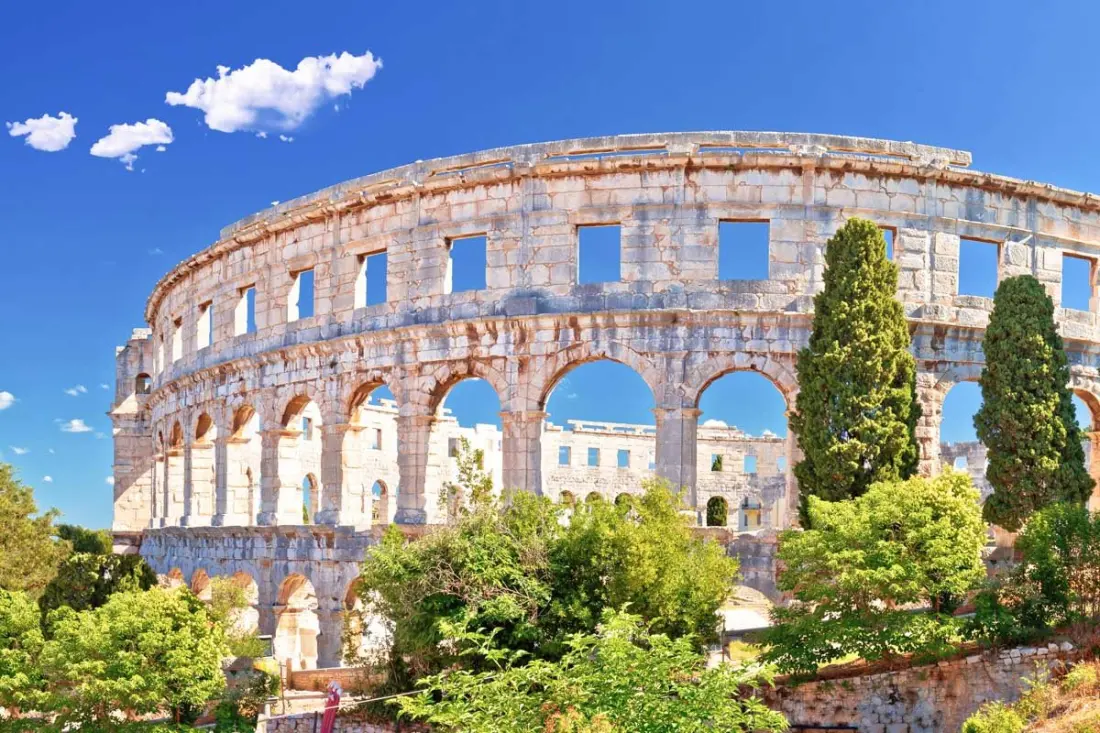
Most people know Pula for one thing: the Roman Arena. And yes, the 1st-century amphitheater is genuinely one of the best-preserved in the world. But this small city on Croatia's Istrian peninsula has more going for it than ancient stonework — a rocky Adriatic coastline dotted with caves, a national park of 14 islands just offshore, and wild bottlenose dolphins living in the surrounding waters year-round.
Start with the obvious. Entry to the Arena costs €10 for adults (under-fives go free), and it's worth paying rather than peering in from outside. Head down to the underground passages, where exhibits cover Roman life in Istria — even olive oil and wine production. Allow an hour or so, and note that in summer the Arena stays open as late as 10 pm. Free multilingual audio guides are available via QR codes inside.
Then get on the water. A three-hour kayak tour from Valovine Beach along the Muzil Peninsula takes in sea caves, snorkelling stops and optional cliff jumping — a much more active way to see the coast than sunbathing on the pebbles. For something slower, the sunset dolphin cruise out of Pula Harbor towards the Brijuni Islands is the standout evening: the writer behind this guide spotted at least a dozen dolphins playing in the boat's wake, with unlimited local wine on board and a pass by the illuminated shipyard cranes known as the Lighting Giants on the return.
Two more boat options round out the list. A four-hour Brijuni National Park cruise includes a swim stop, lunch, unlimited drinks and two hours in the fishing town of Fažana. Alternatively, a five-hour pirate-style boat trip from Medulin (about 20 minutes from Pula by bus or car) passes the 1846 Porer Lighthouse, offers a swim inside Golumbera Cave for confident swimmers, and ends with beach time on sandy Levan Island — a rarity on this mostly pebbly coast.
If you'd rather stay on land, the Lungomare promenade runs about four kilometres along the coast from Valkane Beach past Gortanova Cove, with pine shade, clear water and swim spots the whole way. History fans can add a guided walking tour of the old town and the Zerostrasse tunnels, Pula's underground network.
The suggested itinerary spans three days: ruins and old town plus a dinner cruise on day one, kayaking and the Lungomare on day two, and a Medulin boat trip on day three. May, June and September are the sweet spot — warm but without peak-season crowds. Pula's centre is very walkable, local buses (check Pulapromet) cover the beaches further out, and Bolt taxis fill the gaps.