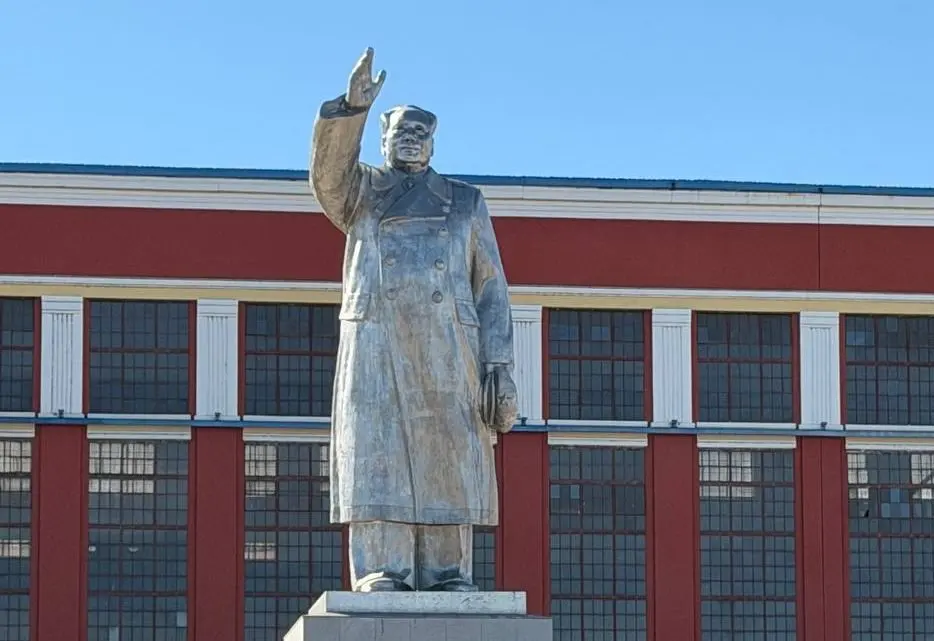
In the industrial suburb of Fularji, about an hour's drive from Qiqihar in China's north-eastern Heilongjiang province, stands a monument that could only exist in a heavy industry town: a Mao Zedong statue cast in stainless steel, made by the very factory it guards. At more than 10 metres tall and over 33 tonnes, it's the largest steel statue of Chairman Mao in China — and by extension the world.
It went up in 1968, at the height of the Cultural Revolution, outside China First Heavy Industries, a giant state factory founded in the 1950s with Soviet help to build enormous industrial machinery. Using steel produced on site was the point: both a tribute to Mao and a statement about the factory's own might. Remarkably, the company still operates today as a state-run entity, though it's had a rough few years financially, and its chairman was arrested on corruption charges in late November 2025.
Qiqihar itself is the real reason to come. This old engineering and railway manufacturing hub boomed during the Communist era, with Fularji as its industrial core, and much of that industry has since faded — leaving abandoned factories and plenty of material for urban explorers. There's railway history too: a Japanese-era station in the city centre and the Russian-built Ang'angxi Railway Station from 1903. The statue is arguably the standout sight in this unlikely red tourism hub, and travellers who make it report it's impressively kept, gleaming in winter sun against a suitably Soviet-industrial backdrop. Expect locals, not foreign tourists — this is deep-cut territory.
Getting there takes commitment. Qiqihar Sanjiazi Airport has direct flights from Beijing (around two hours, roughly RMB 800–1,000 one way), Shanghai, Dalian and Qingdao. By rail, high-speed trains run from Harbin in about 1.5–2 hours (second class from around RMB 98) or from Beijing in six to eight hours. Slower overnight trains from Beijing take 13–15 hours but cost as little as RMB 280 for a hard sleeper.
The statue sits about 40 km from downtown Qiqihar. A taxi or Didi runs roughly RMB 70–120 each way, and travellers with some Chinese can negotiate a half-day hire to bundle in the old stations and derelict industrial sites. Public transport is possible but not recommended unless you enjoy a challenge.
Who is this for? Not anyone planning a dedicated pilgrimage — the writer behind the original guide is frank that no statue justifies 27 hours of trains. But if you're exploring China's north-eastern borderlands, into industrial ruins, or collecting the country's stranger Communist monuments, Qiqihar is a fascinating base, and the steel Mao is its best single sight. Pair it with the railway stations, the urbex scene and onward travel into the far north, and it becomes a genuinely distinctive stop on an offbeat China itinerary.