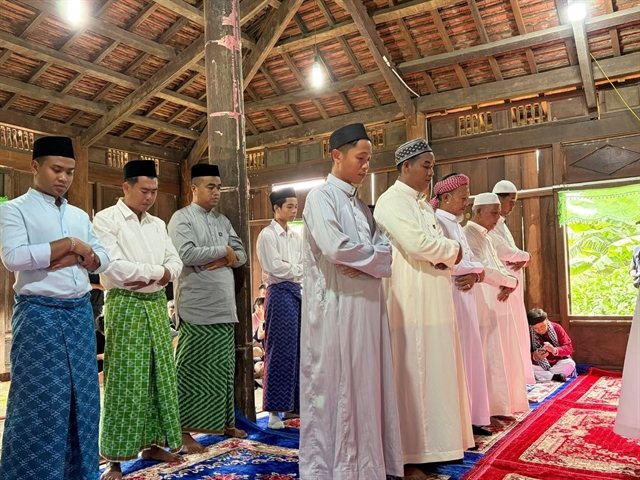
Vietnam is majority Buddhist and folk-religion, but at its southwestern tip, along the Hau River in An Giang Province, a Muslim community has held onto its traditions for centuries. The Chăm people of An Giang close each Ramadan with Raya Aidilfitri, a three-day festival that recently got a public showcase at the Vietnam National Village for Ethnic Culture and Tourism in Dong Mo, Son Tay, outside Hanoi — complete with a reenactment, folk music and plenty of curry.
The festival's timing works differently from a fixed calendar date. Raya falls on the first three days of the tenth month of the Islamic calendar — this year starting October 25 — but the exact day isn't confirmed until elders scan the sky for the new crescent moon on the 29th evening of Ramadan. If the moon shows, the date is set and word spreads through the village the traditional way: drums. If not, everyone fasts one more day.
What makes Raya distinctive here is its emotional core. After the morning prayers at the mosque, attended by men in their finest clothes, people move through the village exchanging not just greetings but 'Maaf' — an explicit request for forgiveness and an offer to forgive, sealed with a handshake or embrace. It turns the festival into an annual community reset.
Then come the tables. Chăm women prepare spiced curries and traditional cakes ahead of the festival, and for three days households fill with visiting relatives, returning family members and neighbours, with trays of sweets and endless invitations to eat. There's a quirk too: Raya is also wedding season in An Giang's Chăm villages, with couples marrying during the three festival days to add to the celebrations.
The Hanoi showcase paired the reenactment with an evening programme called A Love Song of the Cham Village — folk songs and dances with titles like Visiting a Cham Village Girl and The Cham Village by the Hau River — plus demonstrations of silk weaving by moonlight and tastings of the community's cuisine. For travellers who can't make it to the Mekong Delta, it was a rare chance to encounter a culture most visitors to Vietnam never hear about.
Why care? An Giang remains well off the standard Vietnam route of Hanoi, Hoi An and Ho Chi Minh City, yet it offers river landscapes, border-town energy and living minority cultures like the Chăm. If you time a trip with the end of Ramadan and are invited into a household during Raya, you'll experience hospitality that locals describe as genuinely sincere — and cakes worth the journey on their own. For everyone else, keep an eye on the cultural village's programme in Hanoi, which regularly stages authentic community festivals from around the country.