
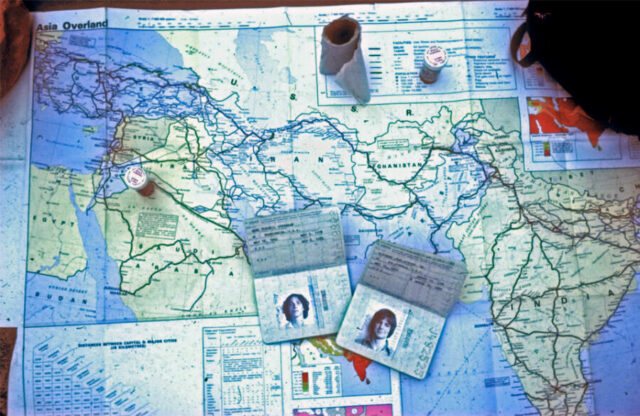
The fall of Kabul prompted travel writer Rick Steves to open his journals from 1978, when — aged 23 — he crossed Afghanistan on the overland Hippie Trail from Istanbul to Kathmandu. His reflections are a window onto a route that has vanished entirely, and they double as the opening of a seven-day series featuring his photos and diary excerpts from that trip.
The journey started badly and got interesting. At the Iran-Afghanistan border, his group walked past the carcasses of VW vans stripped apart by guards hunting for drugs, and past display cases telling of backpackers now serving sentences in Afghan prisons. They kept luggage on their laps to stop anyone planting contraband, then queued for vaccination checks — Steves still recalls the dull needle bending against his travel partner Gene's skin.
Transport was its own adventure. En route to Herat, the minibus driver drew a knife, flashed it in the sun, and announced the tickets had just become more expensive; an Indian passenger talked the outraged Americans down and everyone paid the informal 'welcome to Afghanistan' supplement. The long haul across the country followed what Steves believes was the country's only paved road, a foreign aid project, past desert cemeteries and truck stops where drivers smoked hashish and men sat in circles watching a goat being skinned. Toilet breaks were strictly two minutes: men to the left of the bus, women to the right, robes tented out en masse.
Herat, then western Afghanistan's cultural hub, had just been through a Soviet-backed communist coup. A tank sat on the main square and restaurant menus carried discounted prices annotated 'Thanks to Soviet liberation.' Steves' abiding memories are not of sights but of wandering: markets, gardens, rooftop views of torchlit chariots clattering through the night.
Kabul struck him as less a city than an administrative necessity — a place a country must have in order to be governed, in a land that didn't quite know what to do with one. Yet it produced the moment he calls one of the most impactful of his life. At a backpackers' cafeteria, an Afghan professor joined his table and explained that a third of the world eats with fork and spoon, a third with chopsticks, a third with fingers — 'and we are all civilized just the same.' Steves credits the encounter with rearranging his cultural furniture.
The exit was via the Khyber Pass, ticket stubs stamped with a 'security supplement' paid to the autonomous tribes who controlled the territory between Kabul and the Pakistani border. Rolling past stone fortresses, wind-tattered flags and bearded sentries with vintage rifles, he was happy to have paid it. Beyond the arid mountains, the humid plains of Pakistan and India opened up — which, he writes, felt strangely like coming home.
Why run this on a travel site now? Because it's a rare first-person record of a route and a country that no traveller can visit this way again, and a reminder that people-to-people travel — the whole reason most of us go anywhere — leaves marks that outlast the headlines.