
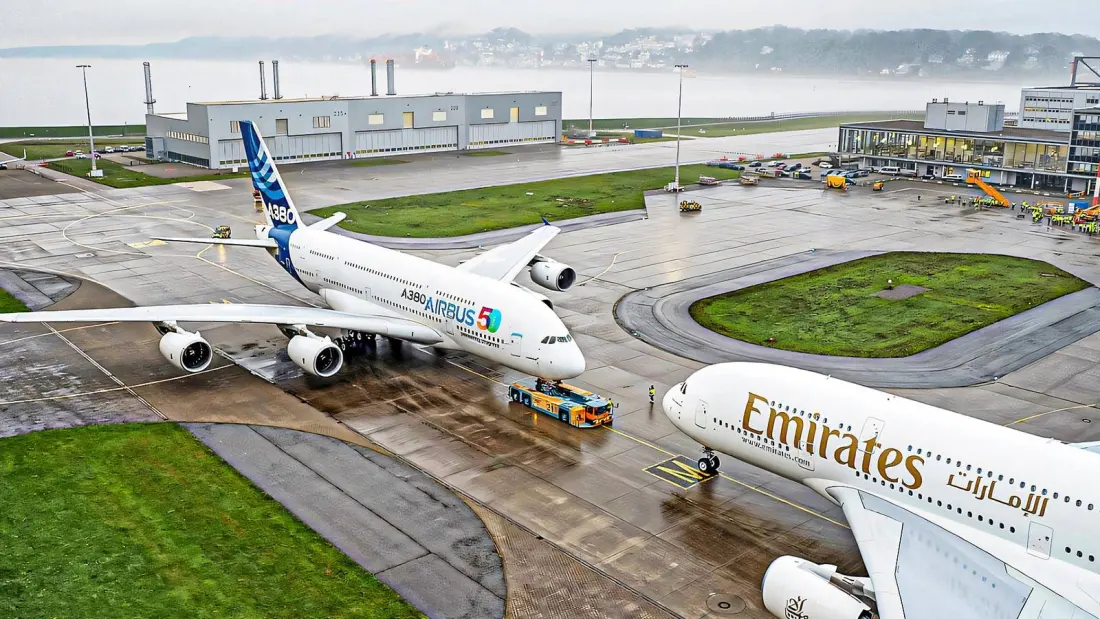
Twenty years after its first commercial flight, the Airbus A380 has gone from a multi-billion-dollar write-off to the aircraft flyers actively seek out. Around 190 of the double-deckers are still flying with ten airlines in 2026, and the ones that survived the pandemic are busier than ever — mostly because no other plane comes close to what they offer on board.
The story of the A380's commercial failure is well known. Airbus built the world's largest passenger jet for a hub-and-spoke era, then the market pivoted to point-to-point routes and fuel-efficient twins. Between 2007 and 2021 only 251 were delivered to 14 customers, and the program never recouped its costs. A rough decade — 9/11, the financial crash, volatile fuel prices — didn't help a four-engine giant. Production ended in 2021.
But the failure was financial, not aerodynamic. Emirates alone took 123 of those 251 airframes — nearly half the total — and bet its entire Dubai hub model on the type. The airline built a dedicated A380 concourse at Terminal 3, does its own heavy maintenance, and has retrofitted most of its fleet. Singapore Airlines ordered 24 as launch customer, and carriers like Qantas and British Airways never gave theirs up. Notably, BA has retired not a single A380 — Heathrow is so slot-constrained that the only way to add seats is to fly bigger planes.
That slot-constraint logic is why the type isn't going anywhere. Air France, Thai Airways, Malaysia Airlines and China Southern have moved on, but the airlines that kept theirs see real value: an A380 moves 480-520 passengers (in typical three- or four-class layouts) in one landing slot, with a range of about 8,000 nautical miles. No replacement exists — the Boeing 777-9, expected to enter service soon, tops out around 426 seats.
For travellers, the A380's real draw is space. Two full decks gave airlines room to experiment, and the results are still the best products in the sky. Emirates pioneered onboard showers for first class and an upper-deck lounge bar. Etihad's A380s carry the Residence — a three-room suite with a private bedroom and shower, one per aircraft across its eight active jets. Singapore Airlines built its first-class suites specifically for the type, with six per plane and convertible double beds in rows two and three. Korean Air even runs an inflight duty-free shop at the back of the lower deck.
Emirates plans to keep its A380s into the 2040s, and there's even chatter — purely speculative for now — about a stretched 777-9 or A350-1000 to fill the capacity gap. Until then, if you want the roomiest, most indulgent long-haul flight available, the A380 remains the plane to pick. Check the aircraft type when booking: Emirates, Singapore Airlines, Qantas and British Airways all fly it on flagship long-haul routes, and even economy feels less cramped when you've got two decks and a staircase to explore.
Story based on reporting by Simple Flying.