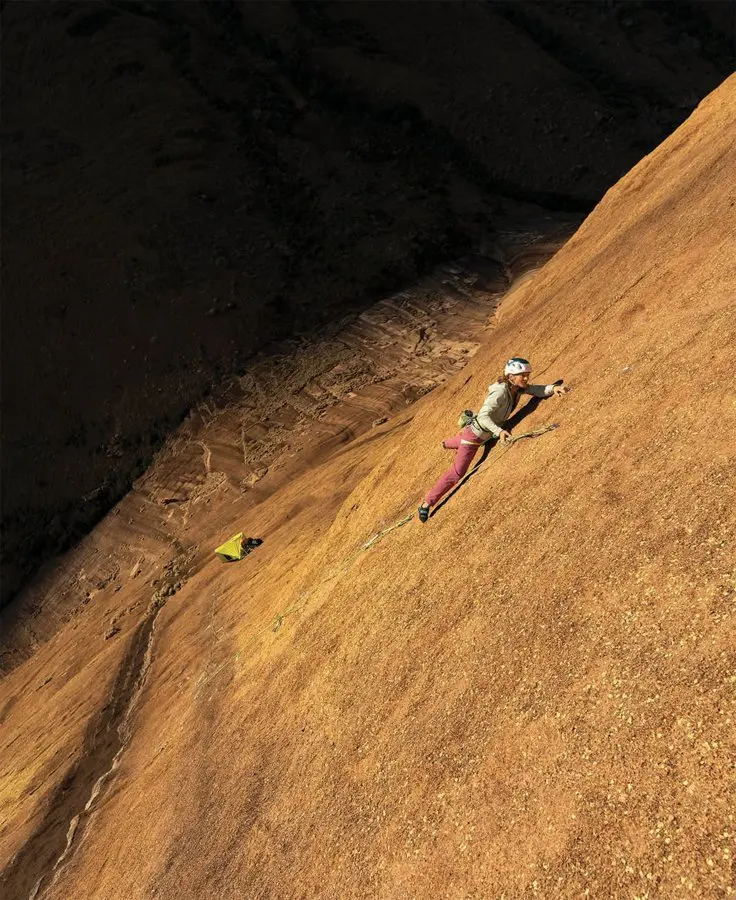
Some of the world's most storied big-wall free climbs are getting a hardware makeover, and the debate behind it says a lot about where adventure travel goes next. A feature in Alpinist follows climbers Daniel Gebel and Dörte Pietron as they re-bolt ageing testpieces in Madagascar's Tsaranoro Valley, where tall, crackless granite walls have become a high-profile stage for a clash between old-school climbing ethics and modern practice.
The backstory is rich. In 1999, Lynn Hill — the first person to free climb The Nose on El Capitan — led a team of women up a new route called Bravo Les Filles, a 600-metre line graded around 5.13d once fully freed. They spent two weeks on the wall, drilling more than fifty bolts from the ground up, a style considered the gold standard of the era. The route was freed in 2004 by Basque brothers Eneko and Iker Pou, and Sasha DiGiulian with Marianna Ordóñez made the first all-female free ascent just recently.
But the bolts placed in 1999 have not aged well. When Gebel and Pietron arrived in 2025 intending to try Mora Mora — a 700-metre, 5.14b route first freed by Adam Ondra in 2010 — they found corroded bolts, hardware placed off the actual free-climbing line, and empty holes where removable bolts had once sat. They abandoned the attempt, climbed Bravo Les Filles instead in a three-day push, and later returned with permission from the original ascensionists to re-bolt Mora Mora properly. That meant hauling drills, bolts, hangers and batteries into a remote valley before the real work even began. Pietron then redpointed every pitch of the route on her first attempts over two days.
The broader point the pair are making reaches beyond Madagascar. At their home crag on Riffeltorkopf in Germany, they broke with local convention by establishing a route top-down rather than from the ground, deliberately crafting a 7c line that ordinary climbers can actually enjoy on a wall otherwise dominated by 8b testpieces. Their argument: a route should be built for the climbers who will follow, not only for the ego of whoever puts it up.
For travelling climbers, the takeaway is practical. Legendary walls in places like Tsaranoro, Yosemite's Tuolumne Meadows and Colorado's Western Slope carry hardware from eras when bolting standards and materials were still being figured out. Check the condition and history of a route before committing, and know that today's version of a classic may look different from the guidebook first ascent — sometimes safer, sometimes straighter, occasionally the subject of heated debate. For non-climbers, the Tsaranoro Valley itself, beneath the granite towers of Andringitra, remains one of the world's more remote and rewarding adventure corners.
Story credited to Alpinist.