A carry-on that fits one airline can be an expensive mistake on another. That's the core lesson from long-term travellers who have spent 20 years and more than 70 countries testing luggage — and their advice boils down to matching the bag to three things: your airline's rules, your packing style, and how you physically move through a trip.
Start with the fine print. North American carriers like American, Delta, United and JetBlue generally allow bags around 22 x 14 x 9 inches with no economy weight limit, while Air Canada and WestJet run slightly smaller. Many international airlines — Emirates, Qantas, Singapore, Lufthansa — cap carry-on weight at 7 to 10 kg. European budget carriers are strictest of all; Ryanair's larger cabin bag must fit 55 x 40 x 20 cm. Remember that stated dimensions include wheels and handles, and the suitcase's own weight counts toward any limit. The writers' rule of thumb: check the three airlines you fly most and buy for the strictest one. (Their bolder move — checking in online, skipping the desk, and hoping gate agents never weigh the bag — has worked on hundreds of flights with only one failure.)
Material matters more than colour. Polycarbonate hardshells are the sweet spot for most travellers: light, flexible, and they bounce back from impacts rather than cracking. Aluminium bags, like the writers' favourite for camera gear, protect fragile kit and close with tamper-resistant latches, but weigh more and dent. Softside bags offer exterior pockets and stretch, at the cost of protection and water resistance.
Then test the moving parts. Four quiet 360° spinner wheels, a stable multi-height telescopic handle, and grab handles top and side will matter on every terminal floor and cobblestone street. Handle placement is an underrated detail: traditional interior handle tubes create ridges you pack around but let a personal-item bag slide on top, while wide exterior handles (as on the new Voyageur 20″) give a completely flat interior but may not hold a backpack in place.
Inside the case, squarer corners and a flat interior beat raw litre counts. Look for compression straps, a wet-dry pocket for damp swimwear, quality YKK zippers or a zipperless latch frame, and a built-in TSA lock. Most hardshells skip exterior pockets, so plan to keep passports and chargers in a personal item.
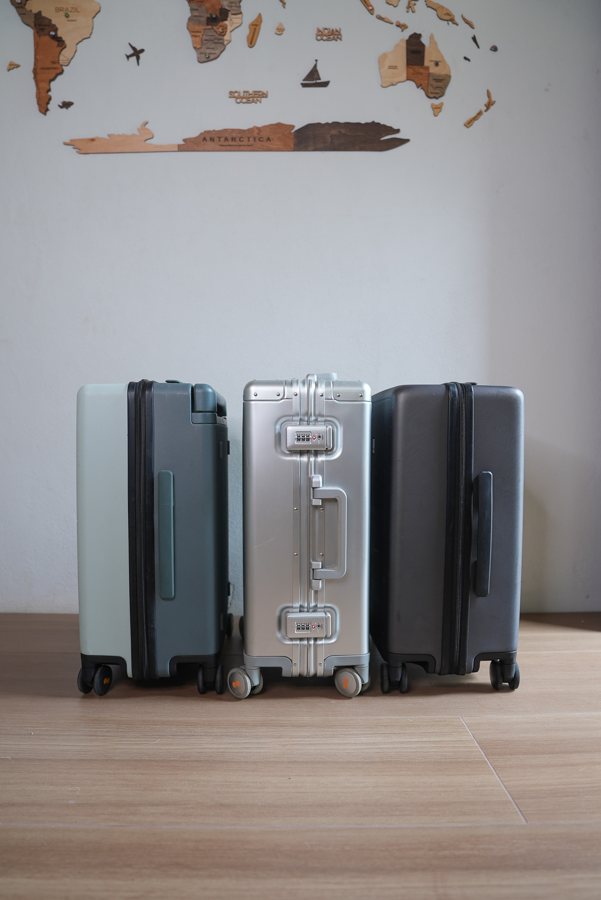
The writers' own comparison is a useful reality check: their Luminous Textured (7.7 lb, 40 L, $169.99) is the lightweight everyday pick; the Voyageur 20″ (8.1 lb, 43 L, $259.99) adds the wide handle and a 43-litre interior they've used for two-week trips; and the Gibraltar Aluminum (10 lb, 36 L, $459.99) is the vault for expensive gear. All three carry a lifetime warranty on functional parts.
Families get a nod too: give each traveller — including kids — their own spinner, colour-code bags, pack by cube and person, and keep a shared essentials bag with snacks, meds and a spare change of clothes. Carry-on-only travel with children is entirely doable with a system.
The takeaway for anyone shopping this year: don't buy the trendiest bag, buy the one that clears your airline's sizer, suits your gear, and rolls smoothly through a real travel day.