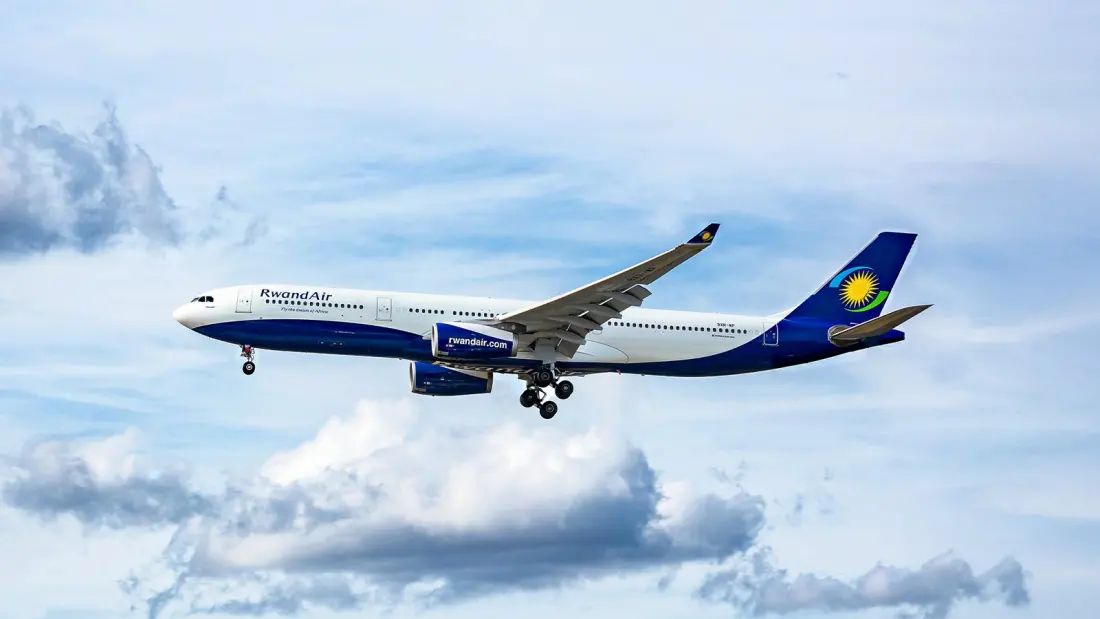
While most airlines chase shiny new jets, Rwanda's flag carrier is taking the opposite route. RwandAir has started adding five leased Airbus A330-200 widebodies to its fleet, with the first arriving at its Kigali hub in August 2026 and the rest due within the current financial year. The move doubles down on a familiar, proven aircraft rather than waiting years — and paying a premium — for next-generation models stuck in manufacturing backlogs.
The logic is practical. RwandAir already flies Airbus widebodies, so more A330s mean shared maintenance, spare parts and pilot training, keeping costs down and getting each aircraft into revenue service fast. Leasing rather than buying also protects the balance sheet. The A330-200's range and payload suit medium and long-haul routes linking Africa with Europe, the Middle East and Asia — exactly where the airline wants to grow.
For passengers, the good news is cabin comfort rather than cabin novelty. Acting Chief Commercial Officer Reuben Mbonye, speaking at World Travel Market in London, confirmed there are no mid-cycle retrofit plans: the existing Business and Economy products stay, including lie-flat beds in business class. He also claimed RwandAir's economy seat pitch compares favourably with rival carriers — a small but real win for long-haul flyers.
Network-wise, the airline runs A330s on its Kigali–Paris and Kigali–Brussels trunk routes, is evaluating Frankfurt, and is studying a return to past high-yield destinations Mumbai and Guangzhou. Rather than squeezing extra frequencies into crowded regional corridors, RwandAir is consolidating a proper hub-and-spoke operation at Kigali, guided by market studies on where each aircraft earns the most.
There's a bigger backdrop too. Mbonye pointed out that Africa holds nearly a fifth of the world's population but accounts for only around 2% of global air travel. Regulatory fragmentation, high fuel costs and intra-African taxes have long held the continent back — which also means an opening for a well-run carrier with reliable widebody capacity. Rwanda's own infrastructure push supports the plan: the multi-billion-dollar Bugesera International Airport, designed for seven million passengers a year, is intended to underpin RwandAir's ambition of roughly doubling its fleet within five years.
Why should a traveller care? If you're flying between Europe and East or Southern Africa, or eyeing an Africa–Asia routing, RwandAir's growth could soon offer more frequencies, better connections through Kigali, and competitive fares on routes dominated by the big Gulf and European carriers — all on a product passengers already rate.