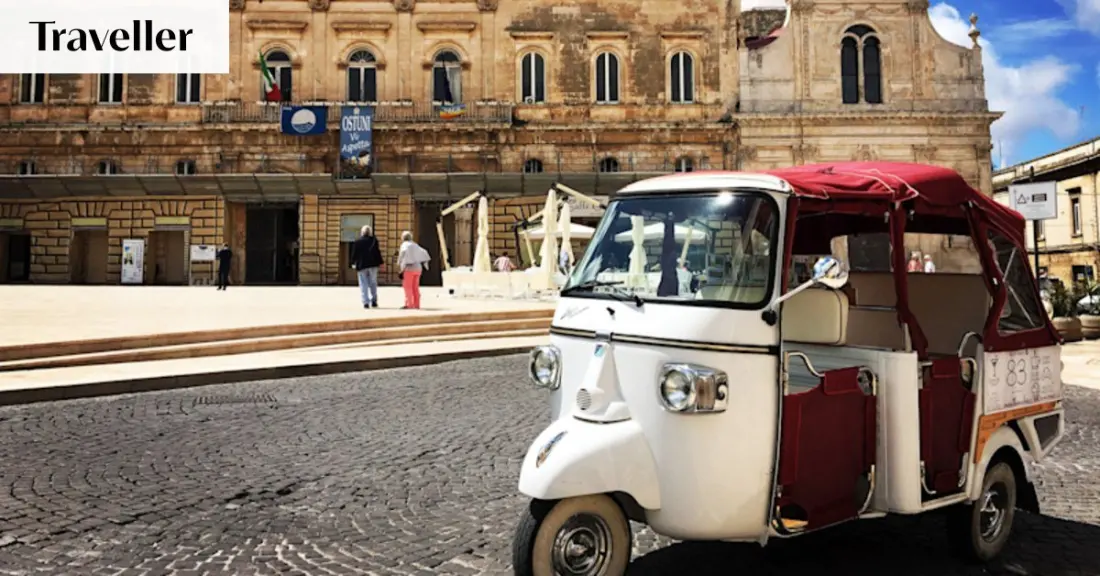
Tuk-tuks might be synonymous with Bangkok's traffic jams, but one of the most charming ways to explore southern Italy right now is on three wheels. In Ostuni — Puglia's famous 'white city' — visitors are zipping through medieval cobbled lanes in an Ape Calessino, a vintage Italian three-wheeler that's enjoying a genuine renaissance as a sightseeing vehicle.
The Ape ('bee' in Italian) was born in the 1950s, designed by Corradino D'Ascanio, the same aeronautical engineer who created the Vespa. Where the Vespa stood for postwar freedom and leisure, the Ape was the working bee — a humble hauler that helped rebuild rural Italy's economy, ferrying goods for farmers and traders through towns too narrow for a van. Later versions, like the Calessino, became open-air passenger taxis, and that's the role they've returned to in places like Ostuni.
The rides themselves are as much about the drivers as the vehicle. On one Collette small-group tour, a fleet of Apes is led by a white-bearded local called Pippo and a crew of twenty-something drivers, all sharing personal stories — the church where he took his first communion 52 years ago, the best vantage points, the maze-like lanes he clearly knows by heart. Passengers bump and judder along cobbles between whitewashed buildings, with breezes drifting up from the Adriatic.
Ostuni itself justifies the trip even without the novelty transport. Its hilltop core gleams white because buildings have traditionally been coated in lime — originally an antibacterial measure against 17th-century plague — and owners are still required to re-lime regularly. The coating has a practical bonus in summer, when temperatures push towards 40°C: it reflects the heat. Around the city, ancient olive groves produce some of Italy's best oil; Puglia as a whole supplies over half the country's olive oil, and some trees here are a thousand years old.
The Ape ride sits within a broader Puglia itinerary that showcases the region's range: seaside strolls and octopus rolls in Otranto, a beach resort guarded by a 15th-century castle; a night in Alberobello's trulli, the surreal cone-roofed stone houses; and baroque Lecce, where tastings of local wine come with a live performance of pizzica, the frenzied folk dance that legend says once cured tarantula bites. Ferries from the nearby port of Brindisi also link the region to Greece, a handy add-on for island-hoppers.
For travellers, this is a story about a classic experience being reinvented locally: the tuk-tuk tour, familiar across Southeast Asia, given an Italian accent and a heritage backstory. It suits visitors who want character and a personal touch rather than a big-bus city sweep — and who don't mind a bumpy ride on ancient cobbles. Pippo's onboard 'massage' joke is earned.