Most people assume a round-the-world voyage needs a 45-foot yacht, a six-figure budget and a retirement date. Carina Juhhova and Christophe Mora spent nearly ten years proving otherwise. Their 25-foot Django 770, L'Envol, has just closed the loop on a circumnavigation of roughly 50,000 nautical miles — and their living costs averaged around £450 a month, boat maintenance included.
Their setup would horrify most marina regulars: no fridge, no shower, no toilet (it's bucket-and-chuck-it with a spray bottle), no heater, no oven and no inboard engine — just a 9.8hp outboard on the transom. Down below there's a V-berth, two bunks and a galley of one pot, a pressure cooker and melamine plates. Christophe's motto: what you don't have, can't break.
The boat choices were deliberate. The Django 770 is a light, infusion-moulded twin-keeler designed by Pierre Rolland, a cousin of Mini Transat racers. Christophe wanted to leave quickly, not spend years refitting, so he bought new — spending more per foot than a used boat would cost — and then modified it for offshore work with a custom hard top, beefed-up winches, a hydrogenerator, a 140W solar panel and a serious anchor setup. The shallow 1.2m draught lets it dry out on beaches, meaning hull cleaning and antifouling cost nothing but patience.
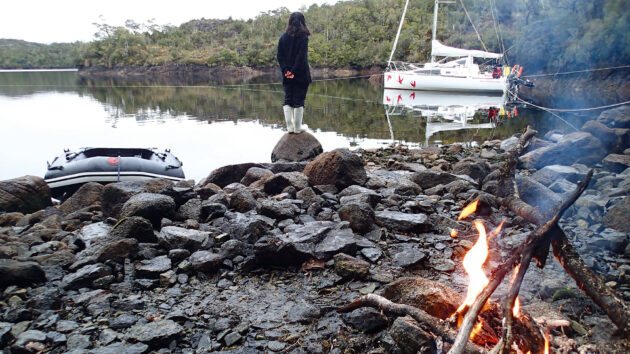
The voyage itself wasn't a gentle milk run. They started from Puerto Williams in Chilean Patagonia, sailed winter fjords where they tied the boat to trees with 400m of shorelines, survived 50-knot squalls near French Polynesia, and spent over a week effectively submarine in 35-40 knot Indian Ocean winds. They crossed the equator without seeing the doldrums and logged a best 24-hour run of 186 miles. Notably, they did it all uninsured — no boat insurance and no health insurance — after companies refused to cover a small solo-capable yacht in the southern latitudes.
The budget works because of how they travel, not just what they spend. They sail rather than motor, anchor instead of paying marina fees, hitchhike ashore instead of renting cars, and haven't taken a single flight. They do their own maintenance and rarely need spare parts. Their fuel use over a year amounts to less than two car tanks.
For anyone who thinks offshore sailing is reserved for the wealthy, this is a genuinely useful counter-example — though it's fair to say the sailors matter as much as the boat. Christophe was a professional mountaineer and ski instructor before converting to the sea; Juhhova had zero sailing experience when she stepped aboard. What they had in common was a tolerance for discomfort, a taste for simplicity and a willingness to start before everything was perfect. Their advice echoes the classic cruising line: go small, go simple, go now.
If you're dreaming of a similar path, the takeaways are practical: buy the simplest boat that's seaworthy, favour light wind ability over motor power, watch weight religiously, and let the wind — not a schedule — set the pace. Not everyone will trade a fridge for freedom, but it's hard to argue with a decade of Patagonian anchorages for the price of a modest city rent. — Yachting World