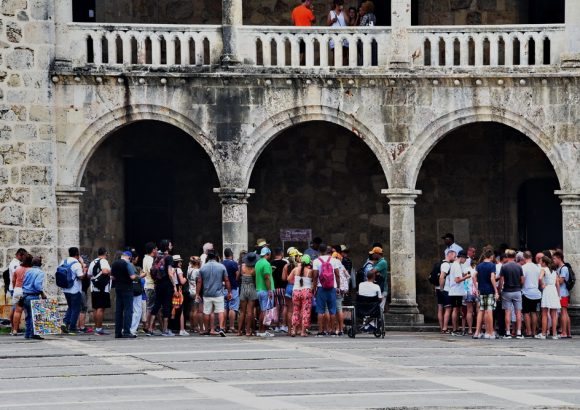
Santo Domingo's old town is having a moment. The Colonial City — the 500-year-old historic core of the Dominican capital — now draws around 14% of all international tourists arriving in the country each month, according to Tourism Minister David Collado. That's double the share of roughly 7% it captured in previous years, and it signals that the Caribbean's oldest European city is finally competing with the beach resorts of Punta Cana for travellers' attention.
The announcement came as Collado unveiled the rehabilitation of two streets in the district, part of a much wider spruce-up. The Ministry of Tourism has already completed RD$468 million worth of restoration work, touching some of the area's most important landmarks: the Gate of Mercy, the Alcázar de Colón (the palace once home to Diego Columbus), the National Pantheon and more than a dozen church facades. On top of that, more than RD$250 million has gone into new sidewalks, curbs and paving — the unglamorous stuff that makes a district walkable.
There's more cash coming. The broader programme includes RD$500 million from the Tourism Ministry and US$90 million from the Inter-American Development Bank, with current projects slated for completion by December. Collado admitted the works have caused disruption in the meantime, but officials say the projects have been coordinated to limit the pain. The government is also eyeing cruise tourism for the district, which would funnel day visitors straight into its cobbled streets.
For travellers, this is a good time to (re)consider the Dominican Republic beyond its all-inclusive beach bubble. The Colonial City is a UNESCO World Heritage site and the first permanent European settlement in the Americas, packed with 16th-century architecture, small museums, plazas and a growing food and nightlife scene. The renovation push means better streets and restored facades, though if you go before the December finish line, expect some sections under scaffolding. Those arriving on cruise itineraries in the future will likely find the district even easier to explore on foot.
The doubling of visitor share also suggests travellers are increasingly pairing a beach stay with a city stop — a combo that works well given the capital's easy air connections. If you've dismissed Santo Domingo as just a transit point to the coast, the numbers say otherwise.