
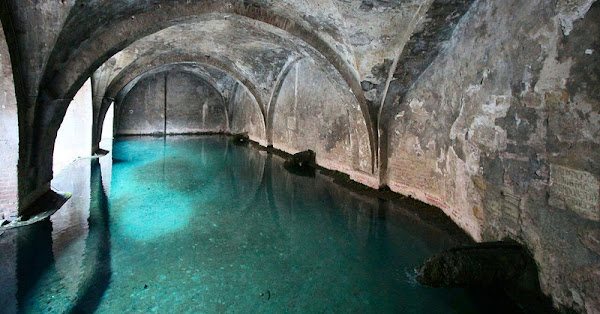
Siena sits on a Tuscan hilltop with no river to speak of, yet for over 600 years it ran a thriving city on water. The secret is under your feet: the Bottini, a network of underground aqueducts stretching roughly 25 kilometres, carved through soft tuffaceous rock to deliver spring and rainwater to the city's fountains purely by gravity.
Some underground channels existed here as early as the Roman era, but the system as we know it took shape from the 13th century, reaching most of its final extent by 1400. The name likely comes from the barrel-vaulted ceilings - botte means barrel in Italian - and appears in records from 1226. Workers called guerchi dug the tunnels by hand in cramped, dark conditions, a job dangerous enough to spawn folklore about goblin-like omiccioli and strange flashes of light known as fuggisoli, probably products of exhaustion and the wine that formed part of their pay.
The galleries are narrow - about 50 to 90 cm wide and up to 2 metres tall - with a small brick channel called a gorello running along the floor. Households drew water through calibrated holes known as dado or forellino, which metered the flow. The network fed Siena's celebrated fountains: Fontebranda, the oldest and most famous, powered laundries, tanneries, dye works and mills, while Fonte Gaia in the Piazza del Campo was supplied by a major branch built around 1300, its overflow feeding smaller fountains downhill.
The tunnels had a military edge too. Because they ran beyond the city walls, entrances were sealed in 1467 amid fears of infiltration, and during the 1554 siege, forces allied with Charles V reportedly tried to use them. As recently as June 1944, partisans weighed using the Bottini to liberate German-occupied Siena before abandoning the idea.
The system remained Siena's main water source until the early 20th century, when a modern aqueduct from Monte Amiata's Vivo springs took over. Much of the medieval network survives in good condition, and portions still feed the historic fountains today. Guided tours occasionally let visitors descend and walk sections of the passageways - a rare chance to see medieval engineering exactly as it was built.
For travellers, this adds a compelling underground layer to an already rewarding city. Pair a Bottini tour (where available) with the fountains themselves: Fonte Gaia on the Campo, Fontebranda near the Basilica of San Domenico, and Fontana dei Pispini. It's a story that makes Siena's street plan click - why every fountain sits where it does, and how a hilltop city without a river became a medieval powerhouse.