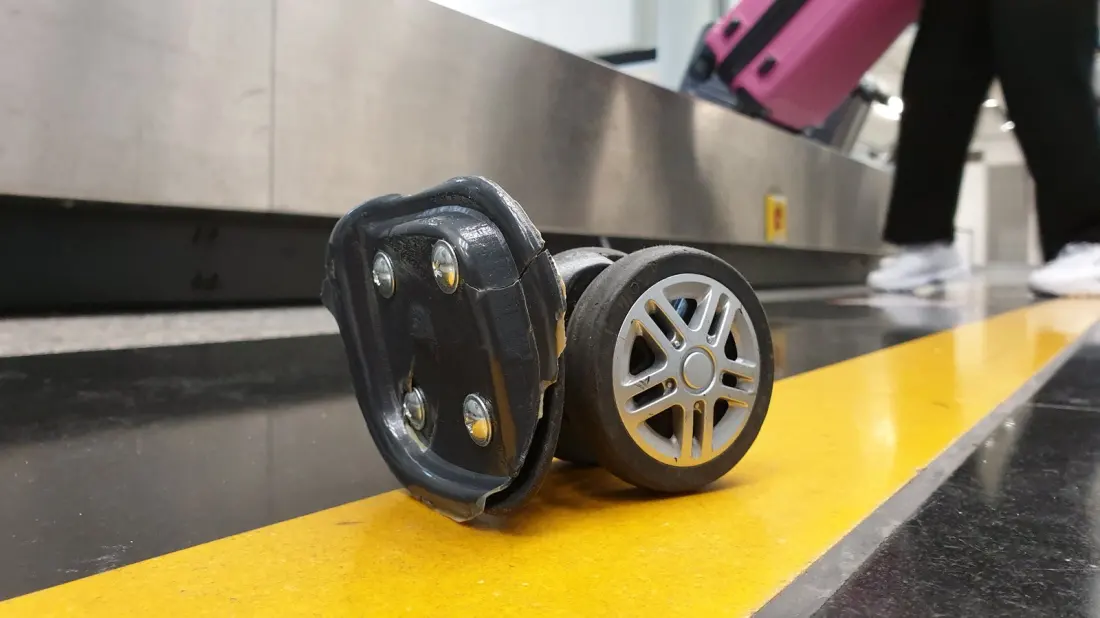
Cracked shell, exploded zipper, one wheel missing? Before you curse the baggage handlers, it's worth knowing how checked luggage actually moves through an airport. Most of the journey from check-in counter to aircraft hold — including the automated sorting — is done by machines, not people. And those conveyor systems and sorters run fast and hit hard. Even the gentlest human crew can't protect a bag from the mechanical handling it goes through behind the scenes.
That's the unavoidable part. Any bag you check will meet this equipment at some point, so the real defence starts before you get to the airport.
First rule: nothing fragile goes in a checked suitcase. If it can shatter, it belongs in your carry-on. Second, don't overpack. Cramming a bag past its limits puts serious strain on zippers, wheels and handles. It might survive the walk to check-in under your careful guidance, but once it's thrown onto a belt, sorted at speed and stacked under other bags, an overstuffed case is far more likely to burst. A heavy bag is also genuinely harder for handlers to lift, which raises the odds of it being dropped or knocked about.
The bag itself can be the culprit too. Cheap suitcases cut corners on the components that take the punishment — flimsy zippers, weak wheels, brittle shells on hard cases, thin fabric on soft ones. Age matters just as much: a well-worn case that has survived a decade of trips is a much better candidate for failure than a newer one, whatever its price tag. If your luggage is showing its age, replacing it before a big trip is cheaper than losing your clothes mid-journey.
For travellers, the takeaway is simple. Buy a decent-quality case, pack within its limits, keep valuables and breakables with you in the cabin, and retire any bag that's already fraying at the edges. You can't control what happens to your suitcase once it disappears down that belt — but you can control what you put into it and what you put it in.