
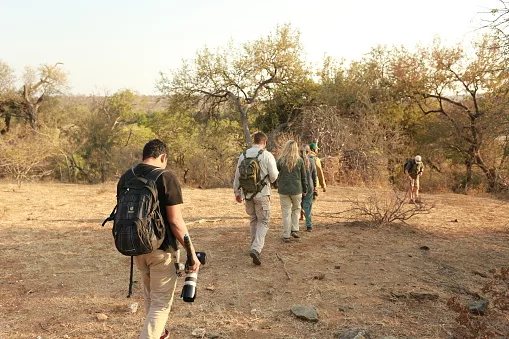
Game drives are the default safari format, but across South Africa there's a strong case for ditching the vehicle. On foot, the pace drops. You start reading tracks in the sand, picking out bird calls, spotting insects and learning how the whole system fits together — things you simply drive past otherwise. Here are six places where walking is the better option.
Kruger National Park needs little introduction, but SANParks runs guided bush walks from several camps that flip the usual script. Small groups head out with armed field guides for a few hours into wilderness areas, shifting the focus from a Big Five checklist to spoor, plants, birds and signs of animals nearby — with the ever-present possibility of meeting something large. It's a solid first taste of a walking safari.
For something deeper, the iMfolozi section of Hluhluwe-iMfolozi Park in KwaZulu-Natal has a walking tradition going back decades, and a conservation history tied to saving the white rhino. Multi-day wilderness trails take experienced hikers deep into Big Five country with armed guides, moving quietly and learning to interpret a broken branch or fresh dung before any animal appears.
The Western Cape offers a completely different flavour at De Hoop Nature Reserve, where fynbos mountains meet the coast. The Klipspringer and Coastal trails start near Koppie Alleen, a famous whale-watching viewpoint, with rock pools and limestone formations along the way. The big draw is the 55km, five-day Whale Trail from Potberg to Koppie Alleen — timed right, you'll watch southern right whales from the cliffs during breeding season. Bontebok, Cape mountain zebra and eland share the reserve, and Potberg hosts the Western Cape's last breeding colony of Cape vultures.
Closer to Johannesburg and Pretoria, Pilanesberg National Park runs guided walks that dig into the smaller stuff — tracks, plants, insects — with the usual tension of bigger game nearby. Families with children under 16 have their own option: a family bush walk in the neighbouring Letsatsing Game Park.
Addo Elephant National Park in the Eastern Cape is famous for its elephants, but its best walking lies elsewhere. The 36km Alexandria Hiking Trail is a two-day loop through forest, dunes and shoreline (the dune crossing demands reasonable fitness), while the shorter Tree Dassie Trail suits beginners. In the Zuurberg section, trails reveal mountain reedbuck, bushbuck and dassies, and the Cannon Trail ends at a beach where you might spot a Knysna turaco inland or dolphins and whales offshore.
Finally, iSimangaliso Wetland Park rewards the slowest walkers of all. At False Bay on Lake St Lucia, self-guided trails like the Mpophomeni and Dukandlovu wind through sand forest and along lakeshores where nyala, bushbuck, hippos, crocodiles and clouds of birds and butterflies appear. It's less about sightings, more about soaking up a whole wetland ecosystem.
The common thread: walking won't necessarily net you more animals, but it changes what you notice. For birders, hikers, families and anyone bored of ticking off the Big Five from a window, these six spots make the case for slowing down.