Most trains connect A to B. These ten do something stranger. A round-up of the world's most inventive railways spans four continents and includes everything from a solar-powered Andean pioneer to a hybrid vehicle that morphs from bus to train in 15 seconds.
The newest star is Argentina's Tren Solar de la Quebrada, South America's first solar train. It runs 42 kilometres through the sacred Quebrada de Humahuaca in Jujuy province, linking remote indigenous communities using lithium batteries charged by panels. Launched in 2024, it now runs wine and dark-sky themed journeys, with an all-stations ticket at $US45.
Japan contributes two very different oddities. The Asa Coast Railway's DMV on Shikoku is a dual-mode vehicle that drives on roads and rails — at the switch point, rubber tyres lift and steel rail wheels drop into place in a quarter of a minute. Meanwhile the Pokémon with YOU Train in Tohoku is a two-hour rolling Pikachu shrine, yellow inside and out, complete with a themed playroom, running between Ichinoseki and Kesennuma for about $15.
Germany's Wuppertaler Schwebebahn looks like science fiction but dates to 1901: a train suspended from an elevated monorail, threading 13 kilometres through the city for the price of a coffee (€7.60 for a day ticket). China has gone one better with the driverless Optics Valley Photon skyrail in Wuhan, which adds a transparent floor so you can watch the world slide past directly beneath your feet. A newer version runs in Chengdu.
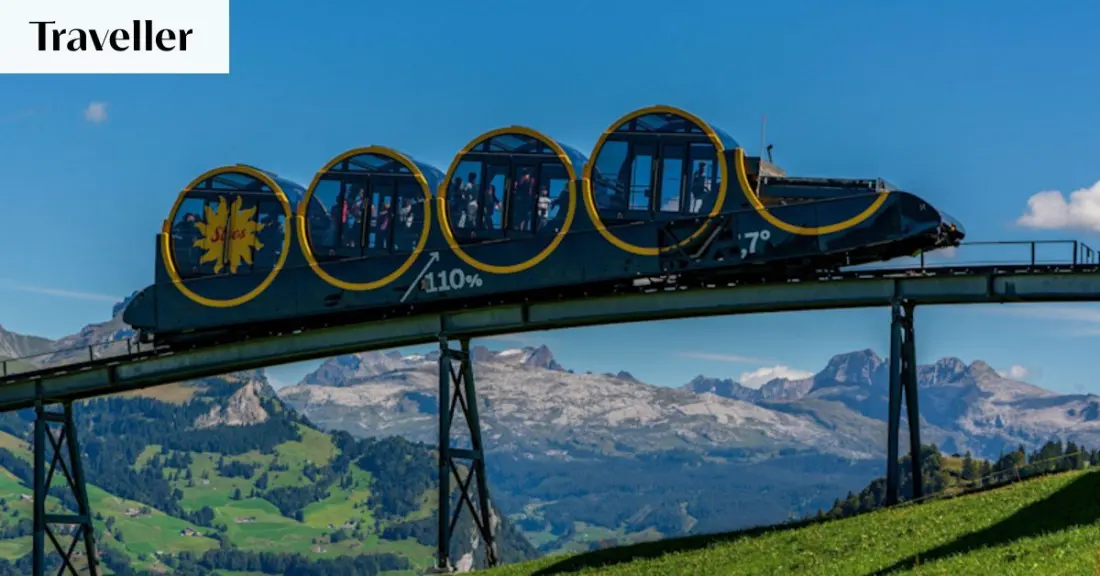
Switzerland's Schwyz-Stoos funicular solves a simple problem — a 750-metre climb at gradients up to 110 per cent, the steepest anywhere — with rotating barrel-shaped carriages that keep passengers level as the track turns vertical. Ecuador's Nariz del Diablo, recently reopened after a landslide closure, tackles the Andes between Alausí and Sibambe by zigzagging forwards and backwards up what looks like a sheer rock face, gaining 500 metres over 11 kilometres.
For lo-fi charm, Cambodia's bamboo norries near Battambang are improvised platforms of wood, bamboo slats and scrap running on engine power at up to 50km/h along war-damaged colonial tracks — $7 for a five-kilometre round trip. Chile's Gondola Carril Ferrobus, a bus body on steel wheels climbing out of Santiago, belongs to the same scrappy family, as does Bolivia's and Colombia's ferrobus network.
Australia flies the flag with the Gulflander, the affectionately nicknamed "train that goes from nowhere to nowhere" — a 151-kilometre line, cut off entirely from the national network, built in the 1800s for a gold rush that never happened. The single-carriage "Tin Hare" takes five hours from Normanton to Croydon through crocodile country in Queensland's Gulf country for a $154 return.
For travellers bored of standard scenic routes, this list is a ready-made itinerary: each ride doubles as an engineering lesson, a local institution and a genuine experience you can't repeat anywhere else.