Southwest Airlines spent more than 50 years perfecting one thing: getting planes off the gate fast. Its famous open seating was never just a quirk — it was an efficiency machine, letting passengers flood aboard and pick any spot, which kept turnarounds down to 25–35 minutes. That matters because many Southwest jets fly five to seven segments a day, so minutes saved on the ground become revenue in the air.
All that changed in January 2026, when the airline rolled out assigned seating across a fleet of more than 800 Boeing 737s. Passengers now board in eight groups (replacing the old A/B/C system), stop at designated rows, and jockey for overhead bin space near their seats. Early reports describe visible congestion, especially on full flights — a real problem for an airline that carried over 134 million passengers a year before the switch.
Here's the math that should worry frequent flyers. If assigned seating adds just five minutes to every turnaround, and 800 aircraft each average five daily segments, that's 20,000 minutes a day — roughly 333 aircraft-hours of lost flying time daily, or the equivalent of nearly 14 whole planes sitting idle around the clock. Even a three-minute slowdown strips out about 200 aircraft-hours a day. And because Southwest runs tight point-to-point rotations with little slack, a morning delay in Dallas can cascade into evening disruptions a thousand miles away.
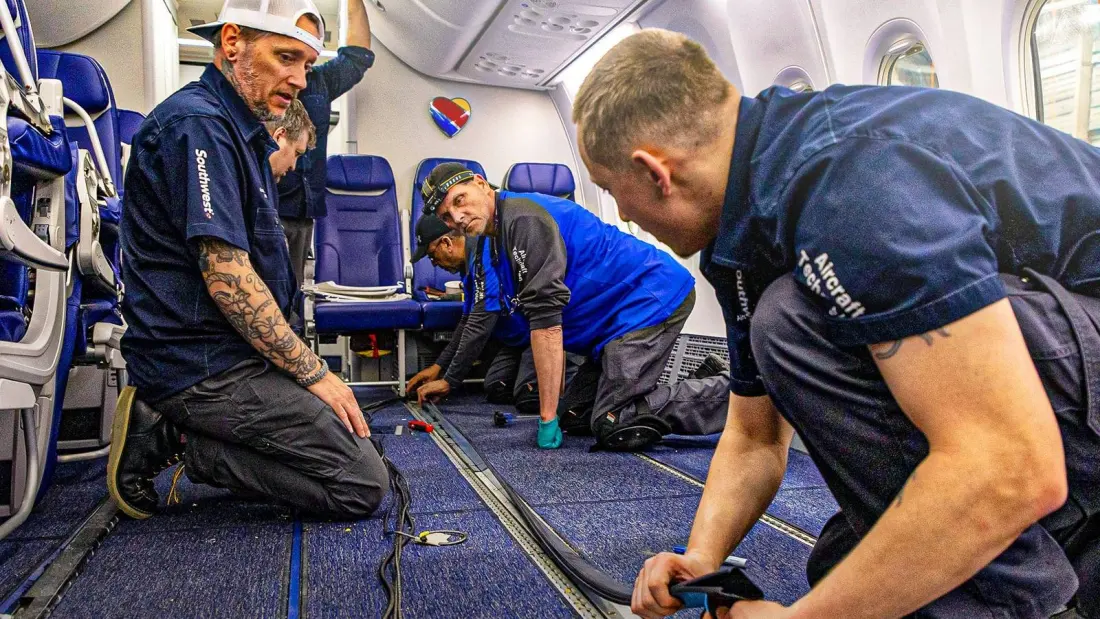
The airline knows it, and is spending accordingly. Around 70% of the fleet will be retrofitted with bigger overhead bins — holding roughly 50% more carry-on bags — by the end of 2026, specifically to cut down on passengers wandering the aisle hunting for bin space.
Why abandon a system that worked for half a century? Money. Rivals have long mined revenue from seat selection, extra-legroom rows and layered fares, and activist investor Elliott Management pushed hard for change after profitability dipped — even though Southwest pulled in about $28.1 billion in revenue in 2025, up slightly from 2024. Assigned seating opens new income streams: preferred seats at the front, premium legroom, sharper fare tiers.
For travellers, the practical upshot is this: the era of grabbing any seat you like on Southwest is over, so if you want an aisle seat near the front without paying, check in early or book a higher fare tier. Expect the boarding experience to feel clunkier for a few more months until the bigger bins arrive, and build a buffer into tight connections while the airline irons out the kinks. What's being tested here is whether extra seat fees can outweigh the erosion of the very speed that made Southwest cheap and reliable in the first place — a bet whose outcome will shape fares and schedules for years.