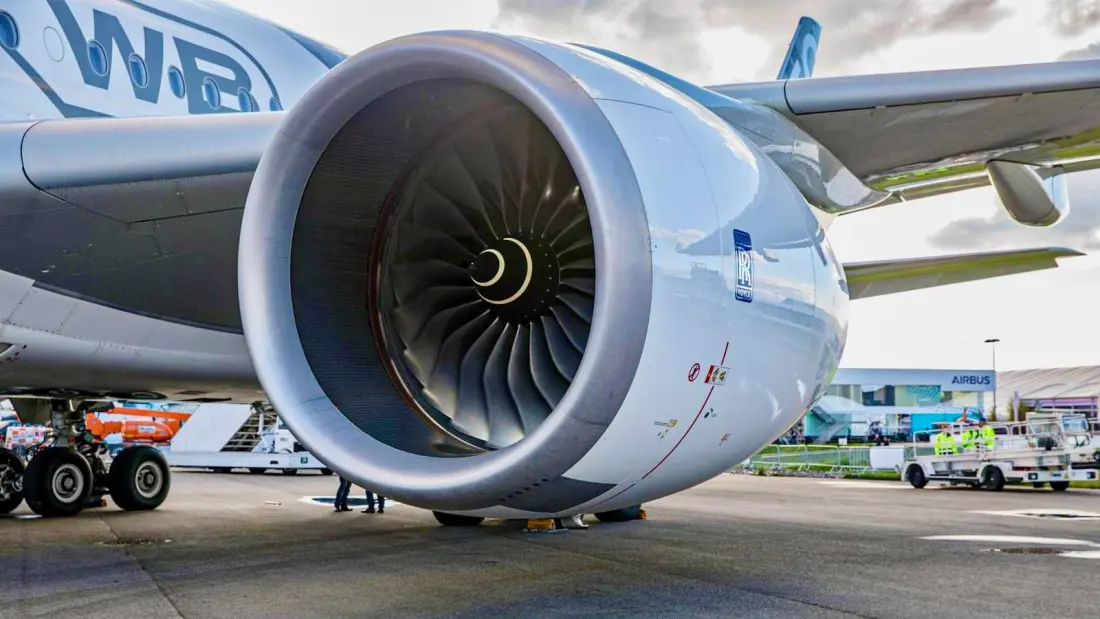
Every Airbus A350 flies on two Rolls-Royce Trent XWB engines, and each one carries a list price of roughly $25 million. That sounds eye-watering until you put it in context: General Electric's GE90 for the Boeing 777 lists at $30 million, and the GE9X on the 777X tops out at around $42 million. Some A350 contracts have reportedly reached $35 million per engine, showing how far list and real prices can drift apart on deals this size.
Here's the thing though — an airline almost never buys these engines outright. They arrive bundled into the aircraft order, tied to a long-term support agreement negotiated at the same time. That support package is where the real money and the real relationship live. Rolls-Royce sells the Trent XWB with TotalCare, a pay-per-flying-hour scheme where the airline pays a set rate for every hour an engine runs, and Rolls-Royce covers overhauls at its own cost. Rolls-Royce actually owns the 'Power-by-the-Hour' trademark and traces the idea back to 1962. Rare published figures hint at the scale: Vietnam Airlines signed a $580 million TotalCare contract covering engines for 14 A350s, while Ethiopian Airlines ordered engines worth $480 million for 12 aircraft and China Eastern committed over $1.1 billion covering 20 A350-900s back in 2018.
Why does an engine cost tens of millions? Materials and precision. Temperatures inside the hot section hit 2,700°F (1,500°C), forcing the use of nickel-chromium superalloys costing around $50,000 per ton — a hundred times the price of carbon steel. The engine swallows up to 1.3 tons of air every second at takeoff, turbine blades spin at 12,500 rpm with tips moving at twice the speed of sound, and the force on a single fan blade approaches 90 tons.
The A350 has a twist other widebodies don't: Rolls-Royce is the sole engine supplier, so airlines can't play manufacturers off each other the way 787 or 777 buyers can. That means less negotiating leverage and typically fixed, high-value long-term agreements that last for the life of the airframe.
The risk transfer cuts both ways. When flying collapsed in 2020 to 43% of 2019 levels, airlines paid by the hour — so Rolls-Royce's free cash flow swung from a £873 million inflow to a £4.2 billion outflow in a single year. The model needs utilisation to work, and utilisation was exactly what vanished.
For a traveller, this is the invisible machinery behind your long-haul ticket. The engine under the wing of your A350 is the opening move in a decades-long commercial relationship, priced so that reliability is genuinely in the manufacturer's interest — engines that stay on wing longer save Rolls-Royce money. It's a decent reason why the type has become such a fixture on intercontinental routes since entering service in 2015, with more than 1,700 engines sold to 46 customers by late 2018 and an exclusivity deal with Airbus running to 2030.