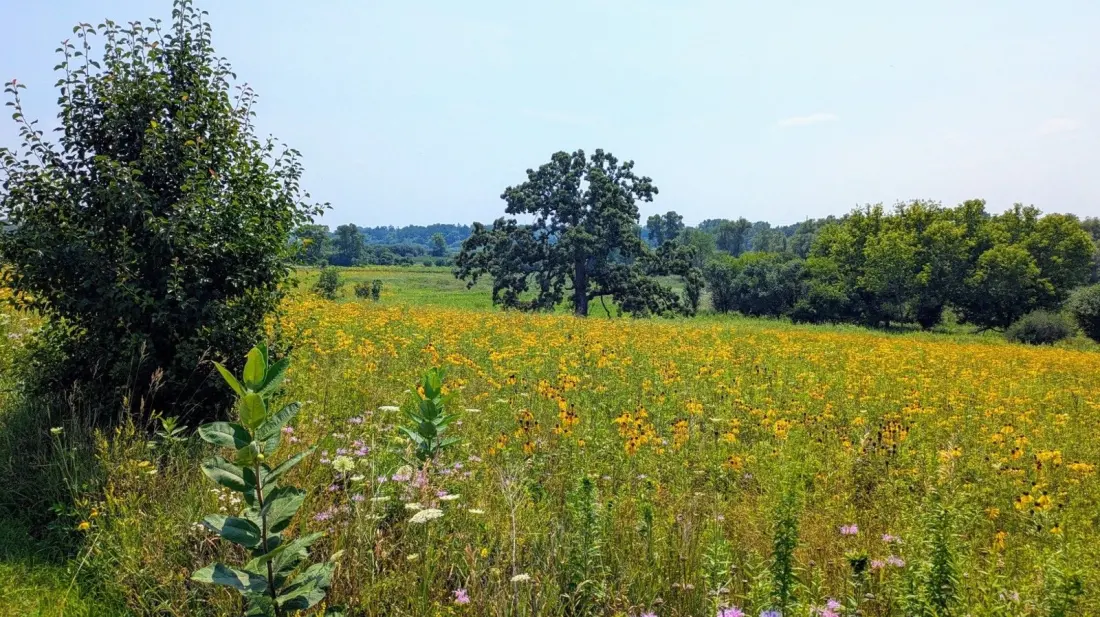
An hour north of Chicago and an hour south of Milwaukee, near the small town of Antioch, sits a 629-acre patch of Illinois that most city dwellers drive right past. Sun Lake Forest Preserve is one of Lake County's quieter natural corners, and it packs a surprising amount into a short loop of trail: prairie, oak woods, recovering wetlands and a genuine glacial lake.
The lake itself is the headline act, even if you can't get up close. Sun Lake is one of the few naturally occurring lakes in a state full of artificial ponds — it was carved by glaciers roughly 10,000 to 12,000 years ago. To protect its fragile banks there are no shoreline trails and no boating, so visitors view the water from a distance across restored wetland plants. What was once drained farmland has been brought back as prairie and marsh, with over 100 acres of replanted prairie now anchoring the preserve.
The trail system totals 3.25 miles, built around a main loop of about 2.5 miles that most people finish in under an hour. It's flat, easy walking — AllTrails reviewers rate it 4.6 stars — running through open grassland and along Sequoit Creek. The main trailhead is at the parking lot off Grass Lake Road, and side paths connect to other access points, including one leading to Longwood Centre Park, home of the Lehmann Mansion, a restored 1912 estate worth a detour for the exterior alone. One honest caveat from hikers: shade is scarce, so bring a hat in summer. Dogs are welcome on leashes, and the preserve is open daily from 6:30 a.m. to sunset with parking and restrooms on site.
For birders, the timing matters more than the miles. Lake County hosts nearly 400 bird species, and Sun Lake sits under the Mississippi Flyway, one of North America's major migration corridors. Peak windows are March through mid-May and July through November, when sandhill cranes, mallards, green herons, field sparrows and other songbirds pass through or settle in. The wetlands also support frogs, reptiles and deer, and volunteers have replanted natives like milkweed, which draws monarch butterflies and pollinators through the warmer months.
Season changes the experience. Spring and summer bring blooming prairie flowers and the best wildlife watching; winter turns the flat loop into cross-country ski terrain, though temperatures can dip below 20°F. Either way, it's a low-effort, high-reward stop for anyone road-tripping the Chicago–Milwaukee corridor who wants a taste of Lake County's 30,000-plus acres of protected forest land without committing to a full-day hike.
If you have time to spare, the surrounding area adds car-free trails, small lakes and a handful of local breweries — enough to turn a one-hour loop walk into a proper slow weekend between two big cities.