The A320's fuselage has flown since the 1980s, so when Airbus wanted the cabin to feel fresher, it couldn't touch the structure. Its answer was the Airspace interior, unveiled at the Paris Air Show in June 2017 and available from 2020 with JetBlue as launch customer. It's a retrofit package borrowed from the widebody A350 and A330neo, and it mixes genuine physical gains with some well-documented psychology.
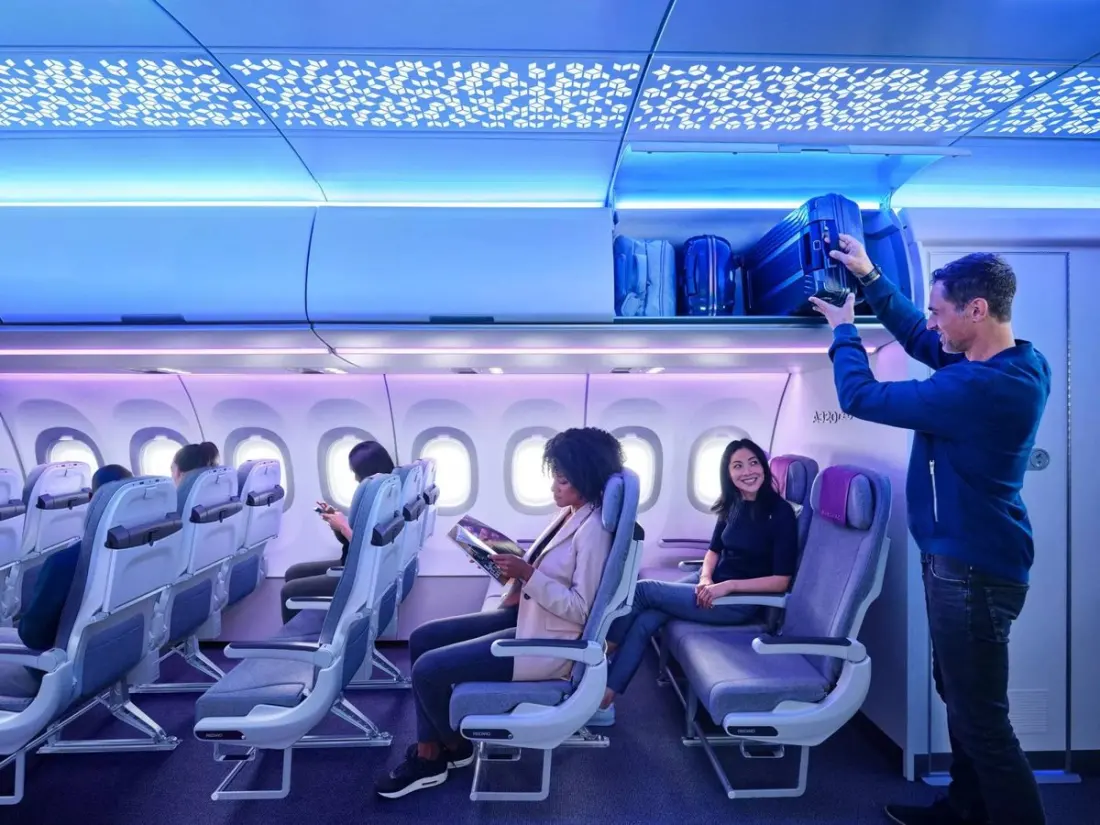
The most tangible change is the sidewalls. Redesigned panels add roughly an inch of width at head and shoulder level, which matters because that's where passengers actually register crowding — research on personal space in cabins consistently points to touch and proximity as the dominant complaints. Combined with the A320's existing 18-inch seats, already wider than the 737's, that inch gives Airbus a legitimate marketing edge over Boeing.
The overhead bins changed more dramatically. Airbus dropped the industry-standard tilt-down design for a fixed configuration that swallows eight bags per four-frame section instead of five — a 40% volume increase. The trick is orientation: bags stow vertically, wheels-down, fitting up to 24 by 16 by 10 inches. Airbus claims the largest bins in any single-aisle cabin, enough for one carry-on per passenger, which should mean fewer gate-checked bags and faster boarding.
Then come the perception tricks. The centrepiece is a 'hero' ceiling light running the cabin's length, with RGB LEDs offering 16.4 million colours. Boeing's own patent on ceiling illumination openly states the goal: to change how tall the ceiling feels. The science is less convinced — a study using eye tracking and VR found window opening size significantly affected perceived spaciousness, while ceiling geometry didn't reach statistical significance. Awkwardly, Airspace redesigned only the bezel around the A320's windows, not the (already smaller-than-737) openings themselves. The integrated shades help, but it's the clearest case in the package of style doing the work of space.
For travellers, the takeaway is honest but useful. Airspace genuinely delivers more shoulder room and meaningfully better bin capacity — those change your flight in measurable ways. The lighting and window styling shape atmosphere rather than dimensions. And the final result still depends on the airline: seat pitch, seat count and density are set by the operator, so a tightly packed Airspace cabin can still feel cramped. Next time you book, the aircraft type is worth a glance — but so is the airline flying it.
Based on a report by Simple Flying.