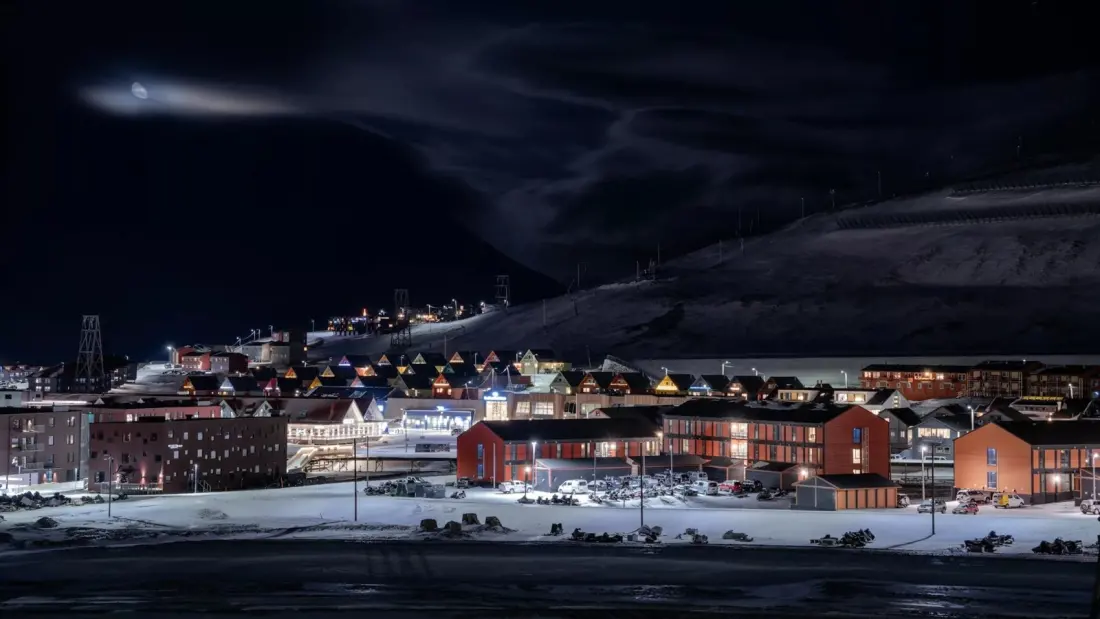
Imagine booking a winter break where the sun doesn't come up at all. On Svalbard, a Norwegian archipelago roughly 1,000km from the North Pole, that's not a weather anomaly — it's the calendar. From around mid-November to late January (in 2026, roughly 14 November to 29 January), Longyearbyen, the main settlement at 78 degrees north, sits in the Polar Night, with the sun below the horizon around the clock.
Counterintuitively, it isn't pitch black the whole time. Around midday a faint blue twilight can brush the horizon, and clear evenings deliver moonlight, stars and — if you're lucky — Northern Lights in greens and purples. Photographers chase those soft blue and pink twilight hours; everyone else tends to settle for hot drinks and very long nights.
The dark season doesn't shut the place down. Guided dog-sledding trips run through snowy valleys behind teams of huskies (on thin snow, some operators use wheeled carts), and snowmobile excursions push far out across frozen terrain to mountain scenery you simply can't reach on foot. Back in town, Longyearbyen has museums, galleries, cafés and restaurants for a settlement of its size. The Svalbard Museum is the standout, covering Arctic exploration, trapping and the coal-mining history that founded the town.
Wildlife is the other big draw. Polar bears are the famous residents, but there are also Arctic foxes, Svalbard reindeer, walruses and seals — and in summer, whales and rich birdlife in the fjords. The crucial caveat: polar bears can turn up anywhere, any time of year. Never approach or seek them out, and don't wander beyond the settlements without serious Arctic experience. Book guided excursions with local operators; the weather changes fast and independent travel here can quickly turn dangerous.
There's a quirky bureaucratic angle too. Svalbard sits outside the Schengen Area and has no separate visa requirement of its own, regardless of nationality. But nearly everyone arrives via mainland Norway, which is inside Schengen — so travellers needing a Schengen visa (South African passport holders, for example) must get one anyway, and it needs to be a multiple-entry visa so you can return through mainland Norway on the way home. A valid passport is required for the Svalbard leg itself.
Practically, most visitors fly into Longyearbyen from Oslo or Tromsø. The town has real accommodation, shops and tour operators, but winter is popular and capacity is limited — book well ahead.
Why bother with a holiday defined by darkness? Because Svalbard runs on a rhythm you won't find anywhere else: months without sunrise, a town built by miners at the top of the inhabited world, and wilderness that remains genuinely wild. It rewards travellers who want an Arctic experience taken seriously — go with guides, keep your distance from wildlife, and let the dark do its thing.