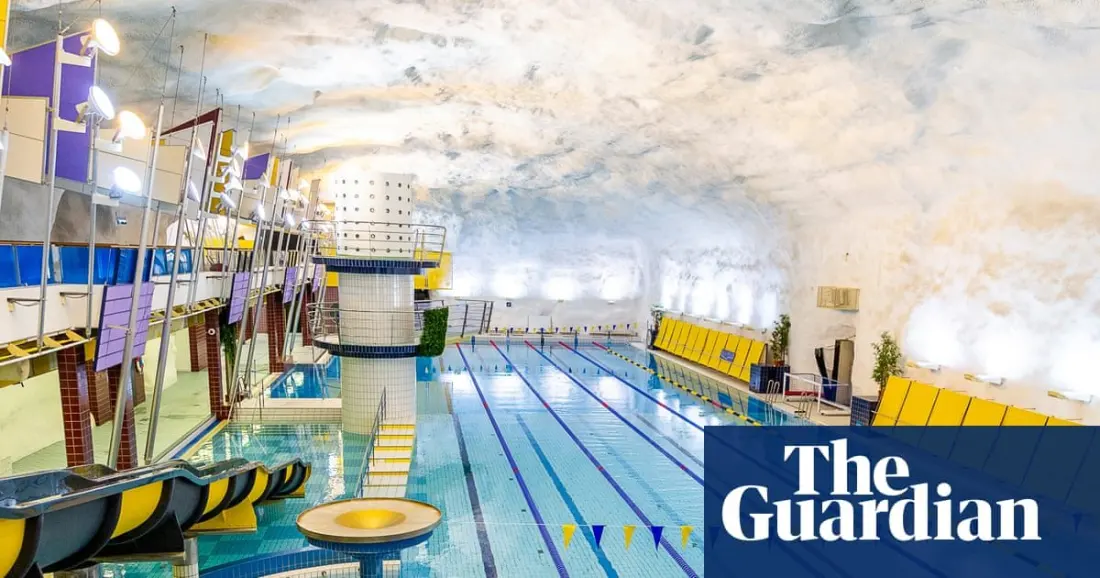
There's a pool in Helsinki where you can do backstroke beneath a fake moon. The Itäkeskus swimming hall, carved out of granite bedrock and opened in 1993, looks like a postmodern fever dream — lavender, yellow and burgundy tiles, giant cerulean triangles hanging overhead, a waterfall roaring beside the lifeguard tower. It draws 400,000 visitors a year. It is also, quietly, a bomb shelter for nearly 4,000 people.
That double life is the point. Helsinki sits on solid rock, and Finns started carving shelters into it during the Second World War. As the city grew, officials faced a choice: scatter heating plants, telecoms cables and sports facilities across expensive surface land, or keep digging down. They chose down. In 2010 the city council approved the world's first officially masterplanned underground city — hundreds of human-made caverns linked by roughly 293km (nearly 200 miles) of tunnels, some reaching 90 metres below street level.
In peacetime, that space hosts shopping malls, a go-karting track, subway stations, playgrounds and pools. If war comes, the whole network can shelter 900,000 people — more than the city's population. The swimming hall can be drained and fitted with decontamination showers in under 48 hours, and you'd never guess it otherwise.
For visitors, the underground world makes an unusual day out, and it's cheap. Entry to all four of Helsinki's public swimming halls is €6 for adults and €3.30 for children, which includes the gym, hot tub, steam room and saunas. Expect the full Finnish experience: the sauna at Itäkeskus is nude and dimly lit, with locals chatting in Finnish, American English and German. Staff speak excellent English and the place is easy to navigate even if you don't read the signs.
Getting there is simple — Itäkeskus station is about 25 minutes on the Metro from the centre, heated carriages included in winter. The exterior is a plain municipal glass box, so the rocky, whitewashed stairway down into the granite hall comes as a genuine surprise.
The pool isn't the only subterranean stop worth your time. Amos Rex, the art museum near the upmarket Kluuvi shopping district, sits beneath the street with sculptural skylights poking through the pavement; tickets start at €20 and children go free. Across town in Töölö, Temppeliaukio church is half-buried in a solid mound of rock — entry is €8, again free for kids. Both double as shelters too.
Why care? Because Helsinki has turned civil defence into something genuinely pleasant — infrastructure you'd choose to visit even without the wartime function. Budget travellers get a warm swim and sauna for the price of a coffee, families get an indoor option for dark winter days, and design-minded visitors get a rare look at a city planned in three dimensions. Few places let you say you swam lengths in a bomb shelter and enjoyed it.
The story comes from The Guardian Travel.