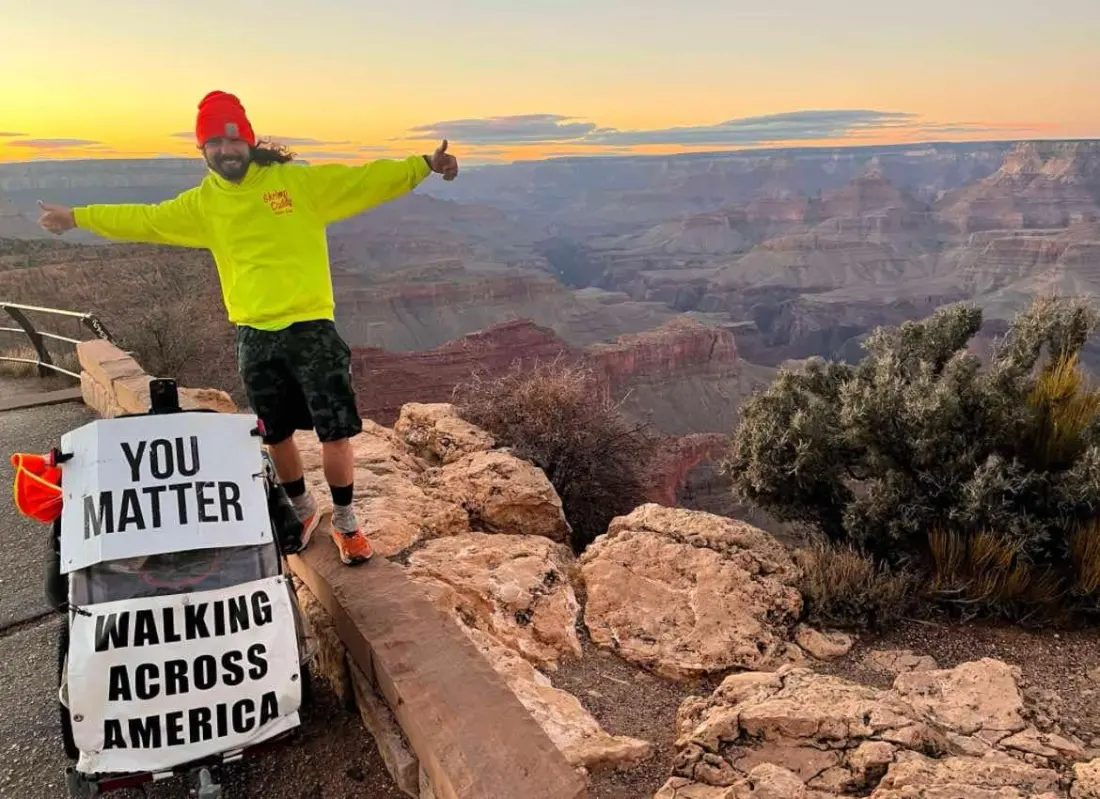
Most people fly coast to coast in five hours. Kyndal Ray Edwards just spent 1,022 days walking the edges of the United States — 19,544 kilometres in total — and last week he finally stopped moving.
The 33-year-old from Orange Park, Florida, began his project on January 1, 2022, from a beach in Jacksonville. His first goal was simple enough: reach the Pacific. That alone took 15 months and 5,298 kilometres, ending at Long Beach, Washington. Then the plan grew. Instead of heading home, Edwards decided to walk to all four corners of the contiguous United States. From Long Beach he continued to Cape Flattery, the country's northwestern tip, then south along the coast to San Diego — corner two. From there he turned around and trekked the entire length of the country back to Florida's southeastern extremity, before setting off north again for the final leg.
He reached the finish line — West Quoddy Head Lighthouse in Lubec, Maine, the northeasternmost point of the US — on October 25, greeted by a crowd of supporters. His daily average of nearly 20 kilometres, sustained for almost three years, is the kind of consistency most ultra runners only manage during a race.
The story behind the miles is what makes it worth following. Edwards has been open about his early adulthood spent battling drug addiction, mental illness and the justice system, and he framed the walk as both an athletic project and a recovery journey, documenting both on social media throughout. The trek was a dream he'd carried since 2013.
He isn't slowing down, either. Among the ideas floated online since finishing: adventures with a stranger in all 50 states, more ultra marathons, and endurance challenges on every continent. He's also in good company — his finish came just days before Karl Bushby wrapped up his 28-year Goliath Expedition, and the two long-distance walkers, Edwards noted, happen to share a birthday.
Why does this matter for travellers? Because Edwards's route is essentially a blueprint for some of America's most under-visited coastlines and corners — the rugged Olympic Peninsula around Cape Flattery, the wild shoreline of Maine near Lubec, and the quiet stretch of northern Florida most visitors skip on their way to theme parks. You don't need three years to see them. Pick one corner, rent a car or hike a section, and you'll get a version of the US that cruise-ship and highway tourism rarely touches. His route also doubles as inspiration for walkers planning shorter long-distance trips: the Atlantic-to-Pacific leg alone is the kind of challenge that ambitious hikers could break into summer-sized chunks.