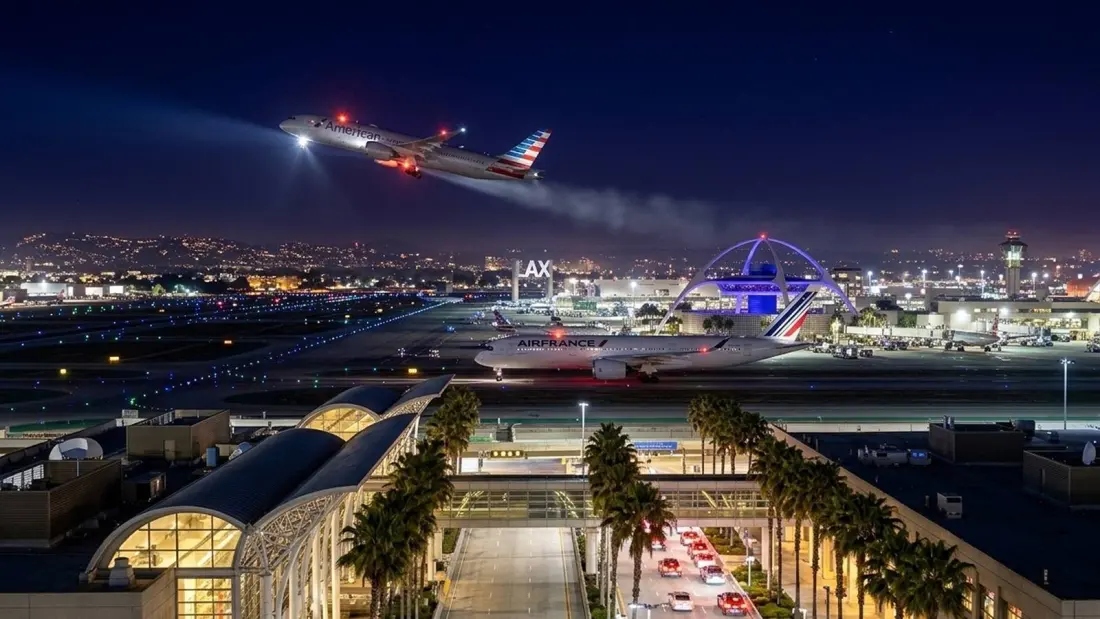
Two airliners leaving Los Angeles International Airport in the early hours of Saturday, November 7 came startlingly close to colliding, and it was a quick-thinking controller who stopped it happening.
Air France flight 28, an Airbus A350-900 registered F-HUVK and bound for Papeete in French Polynesia, departed LAX at 12:15 AM. Just a minute later, an American Airlines Airbus A321 (flight 1660 to Dallas/Fort Worth, registration N191UW) followed it off the runway. Between them, the two aircraft could have been carrying more than 500 people.
The Air France jet had been cleared on the SUMMR2 departure — an FAA-defined route that sends westbound traffic straight ahead after takeoff from LAX's 24L/R and 25L/R runways before turning out over the Pacific. The American A321 was told to level off at 2,000 feet while the widebody ahead climbed away, then continue up to flight level 270. Instead, the A350 made an unauthorized left turn shortly after leaving the ground, cutting across the path of the departing American jet. The two aircraft lost standard separation, coming within roughly 400 feet of each other vertically.
The departure controller spotted the developing conflict almost immediately and issued turns to both aircraft, splitting their paths before anything worse could occur. When questioned, the Air France crew was pressed on why it had strayed from its assigned routing. Both flights went on to reach their destinations normally, with no injuries or damage reported. Air France had not responded to requests for comment when the story broke.
It is also not an isolated scare. Earlier in 2025, an American Airlines jet and an ITA Airways aircraft had another close call near LAX after a pilot deviation from the same airport. With departures funnelling off parallel runways onto carefully choreographed routes, there is little margin for an unplanned turn.
For travellers, this story is a reminder of two things. First, the system works: separation incidents sound alarming, but controllers catch most of them before passengers ever notice, and both flights here continued uneventfully. Second, LAX is one of the busiest airports in the world, and the procedures governing its departures — like SUMMR2, which feeds long-haul flights toward Hawaii, Asia and coastal destinations — exist precisely because the airspace is crowded. If you were on either of these flights, you likely never knew how close things got. If you are flying through Los Angeles this holiday season, the practical takeaway is simply to expect busy skies, allow buffer time for connections, and trust that the people on the radio are watching closely. Details of the incident come from flight-tracking data and FAA procedure documentation reported by Simple Flying.