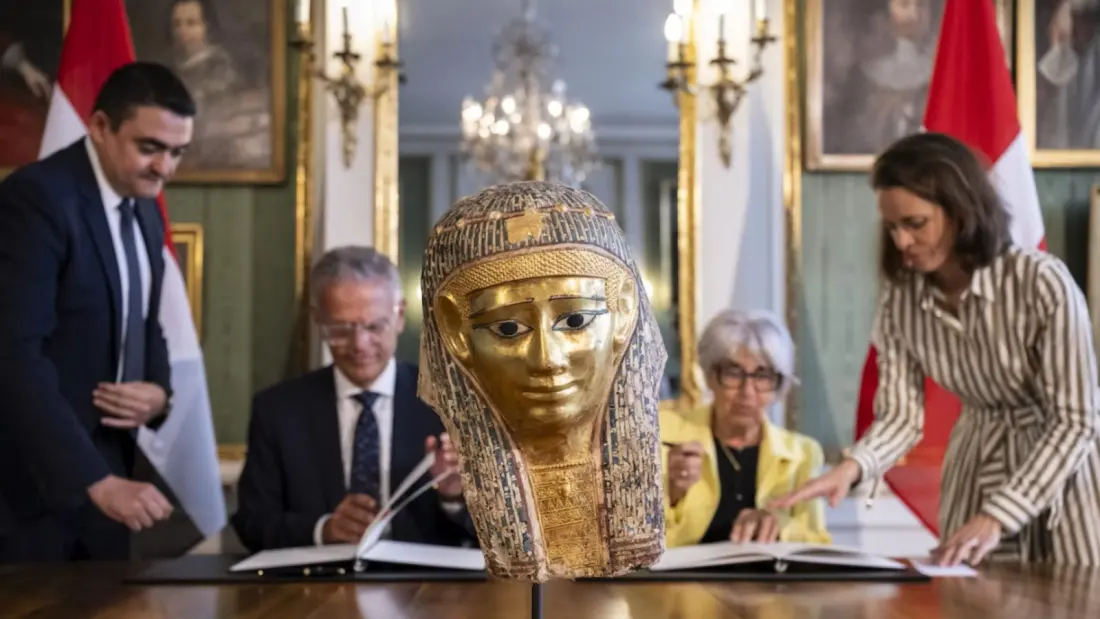
Switzerland has returned an ancient Egyptian funerary mask to Cairo, the latest move in a quiet but steady campaign by the two countries to undo the damage of the illicit antiquities trade.
The piece dates to the Ptolemaic era — the dynasty that took hold after Alexander the Great's conquests and ended with Cleopatra — making it well over two millennia old. Swiss customs officials seized it back in 2022, and after examination and authentication by experts it was confirmed as a genuine Egyptian artifact from that period.
The formal handover happened in Bern, where Swiss Federal Councillor Elisabeth Baume-Schneider presented the mask to Mohamed Nagm, Egypt's ambassador to Switzerland. The embassy announced the repatriation on 16 September, framing it as part of an ongoing partnership on cultural heritage protection.
This isn't a one-off. Switzerland has handed back roughly 80 cultural and archaeological objects to Egypt since 2011, part of a long-running cooperation between the two governments to track down items that left the country unlawfully. Bern's role matters here: Switzerland's historically permissive art-market rules long made it a hub for looted antiquities, which makes these returns more significant than the headlines suggest.
Why should a traveller care? Egypt's museums are the direct beneficiaries of repatriations like this one. The Grand Egyptian Museum in Giza has been opening its full collection in phases, and objects recovered from abroad often end up on public display rather than in storage — meaning visitors eventually get to see them in the country they came from. For anyone planning a trip built around ancient Egypt, knowing that pieces like this mask are coming home is a reason to keep an eye on what's on show in Cairo and Giza.
It's also a nudge towards travelling ethically: buying ancient coins, pottery fragments or carved scarabs as souvenirs can feed exactly the trade these repatriations are fighting. Egypt has spent years pursuing smugglers and collectors, and the Swiss partnership shows those efforts increasingly pay off.
If a Ptolemaic mask has you sketching out an Egypt itinerary, there's plenty to anchor it beyond the Pyramids. The Ptolemaic story lives strongest in Alexandria — founded by Alexander himself — where catacombs, Pompey's Pillar and the Bibliotheca Alexandrina tell the Greek-Egyptian chapter of history that a mask like this belongs to.
Story via Egyptian Streets.