Most American travellers to the UK follow a familiar circuit: London, Edinburgh, maybe Manchester or Liverpool. VisitBritain's own numbers show a steep drop-off after those five, which means cities like York, Norwich, Cardiff and Stirling go largely unvisited — despite packing in history that rival anywhere on the usual itinerary.
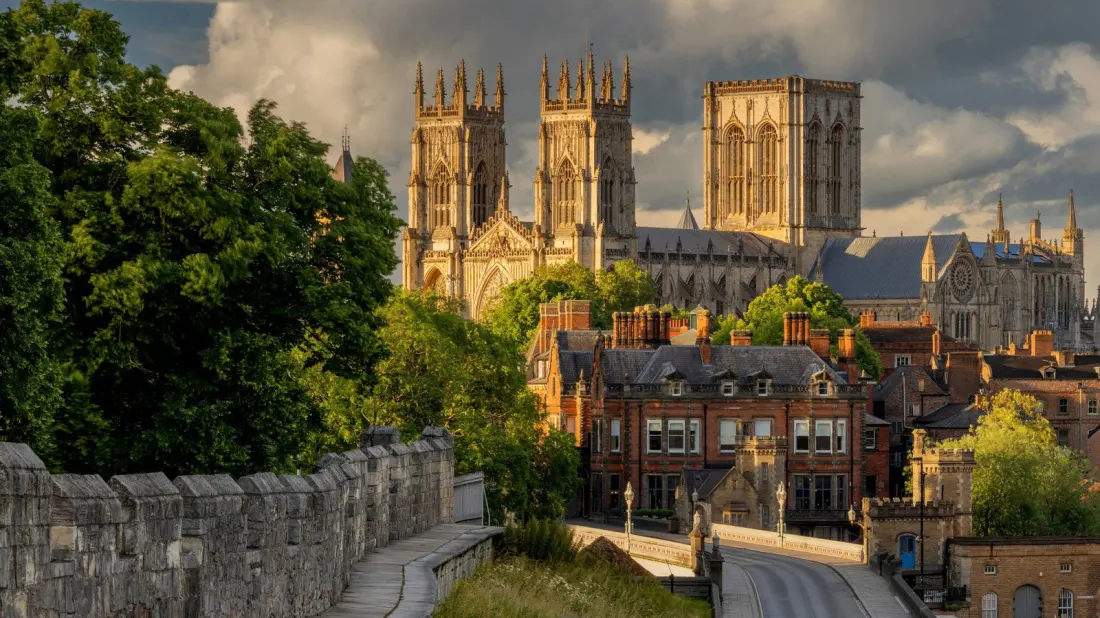
York, sitting conveniently halfway between London and Edinburgh, is arguably the strongest case. Founded as the Roman garrison of Eboracum and later the Norse trading hub of Jorvik, it has two millennia of layered history. York Minster, a Gothic cathedral finished in 1472 after more than 250 years of construction, dominates a medieval centre of crooked timber-framed lanes — The Shambles being the most famous — all ringed by intact 13th- and 14th-century walls.
Glasgow gets a fraction of Edinburgh's visitors (the capital drew more than three times as many in 2024) but was voted the UK's friendliest city in 2022. Nearly all its museums are free — Kelvingrove holds ancient Egyptian artefacts, WWII pieces and a Dalí — and the city was the UK's first UNESCO City of Music. It's also home to King Tut's Wah Wah Hut, the venue where Oasis were famously discovered in 1993.
Chester, a short hop from Liverpool and Manchester, is usually reduced to a day trip. It deserves longer: the Romans founded it around AD 79, and its double-tiered 'Rows' shopping streets date to the 13th century. The city walls form the most complete circuit in Britain on a 2-mile walk, the amphitheatre is Britain's largest, and its racecourse has been running since 1539 — the longest continuously operating one in the world.
Belfast, once avoided during the Troubles — the conflict claimed more than 3,500 lives before the 1998 Good Friday Agreement — has reinvented itself around the Cathedral Quarter's independent bars, restaurants and Michelin-starred dining. The Crown Liquor Saloon, with its mosaic floors and carved woodwork, counts among the most ornate pubs anywhere. Guided tours led by former combatants from both sides walk the murals and peace walls, a record of the conflict found nowhere else in the UK.
Norwich was medieval England's second city and still holds more surviving medieval churches than any city north of the Alps — over 30 have been repurposed for theatres, galleries and antiques dealers. Its Norman castle keep, built in 1121, reopened after restoration with all five floors visitable, displaying nearly a thousand artefacts including a 500,000-year-old hand axe.
Cardiff is Europe's most affordable capital, or close to it. Cardiff Castle stacks a Norman keep beneath a Victorian Gothic mansion with gilded interiors, Cardiff Bay hosts the Wales Millennium Centre, and the city claims more Victorian and Edwardian shopping arcades than any other in the UK — including Spillers Records, the world's oldest record shop. Stirling rounds out the list with its cliff-top castle and compact old town.
The takeaway: anyone with a few extra days beyond the headline cities can add a millennium or two of history, friendlier crowds and lower prices by routing through these places. Trains connect most of them easily, and locals are famously glad to see visitors who make the effort.