Tesla has started pushing out FSD v15, the latest version of its Full Self-Driving software, and it's a bigger deal than the usual over-the-air patch. The entire end-to-end neural network has been rebuilt, and Tesla claims the system now handles safety-critical, high-risk situations up to 25 times better than before — a jump in what the company calls the critical intervention rate.
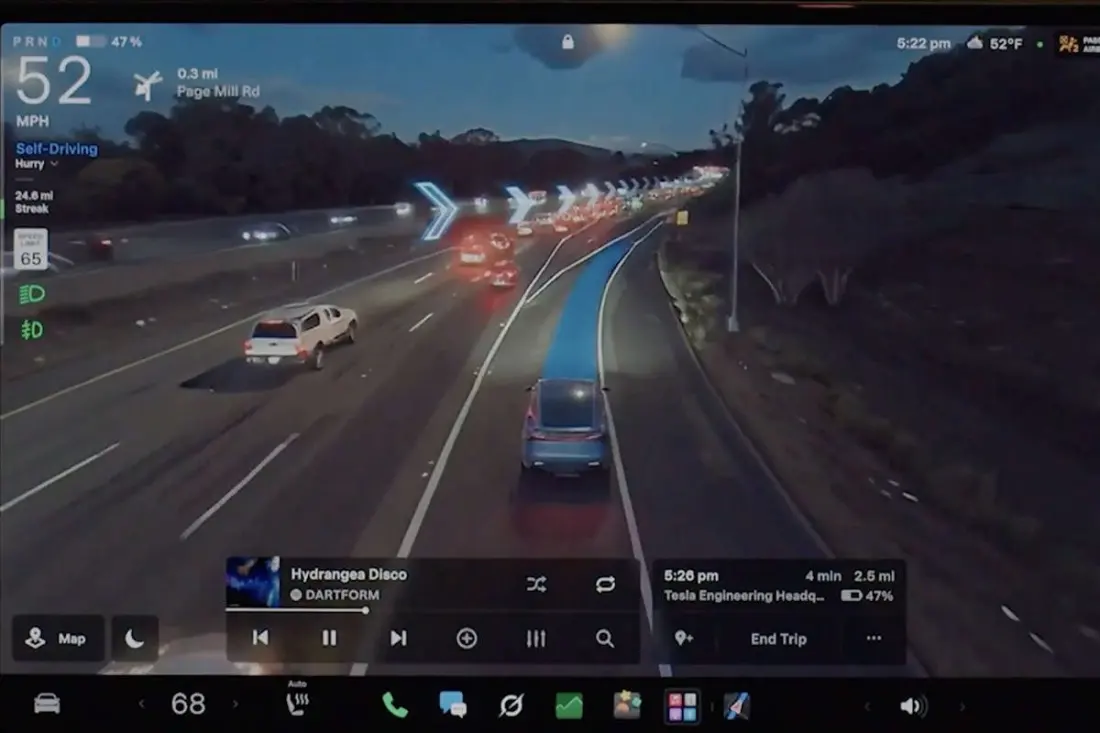
The flashiest addition is Tesla Reality View. Instead of the old grey background with basic 3D car shapes, the screen now renders a live, generated recreation of the road around you, built from cameras mounted above and behind the vehicle. Elon Musk has compared the effect to Grand Theft Auto. It isn't just eye candy: Reality View shows planned turns, lane changes and evasive moves in real time, and drivers can tap the screen to adjust or override them. Four layouts are available — fullscreen, split view with the map, a map-first mode, and Quiet Mode, which strips back the visuals so they don't distract.
Under the surface, the navigation model has been retrained to handle the awkward bookends of a drive: tight alleys, car parks and pick-up zones. It learns from route choices across the whole Tesla fleet, and a later v15 release will extend that learning to full routes. The computer vision has also been taught to spot low, easy-to-miss hazards — potholes, debris, animals and standing water — and to slow or swerve smoothly around them. Behaviour in school zones, heavy rain and poor visibility gets more natural speed adjustments too.
There are a few quality-of-life touches as well. Speed cameras now trigger an automatic slowdown, though a press of the accelerator cancels it — decline twice at the same camera and the car remembers not to nag there again. Turn signal clicks are softer and fade out after a while. And for road-trippers with gear, the new Bike Rack Mode keeps driver-assist active with a hitch-mounted rack fitted, recalculating clearance and sensor angles while switching off Autopark, Summon and backup alerts.
Why should a traveller care? FSD is still a driver-assist system, not full autonomy, and availability varies sharply by country — it remains restricted or heavily supervised in many markets, including most of Europe and Asia. But if you rent or drive a Tesla on holiday, these changes will shape the experience: clearer visuals of what the car intends to do, smoother reactions to potholes and flooded roads, and — finally — no more having to disable assistance because there's a bike rack on the back. It's a sign of where assisted driving on rental and private cars is heading, even if your next trip is still very much on you.
Full details of the release were shared by Tesla via Platform X.