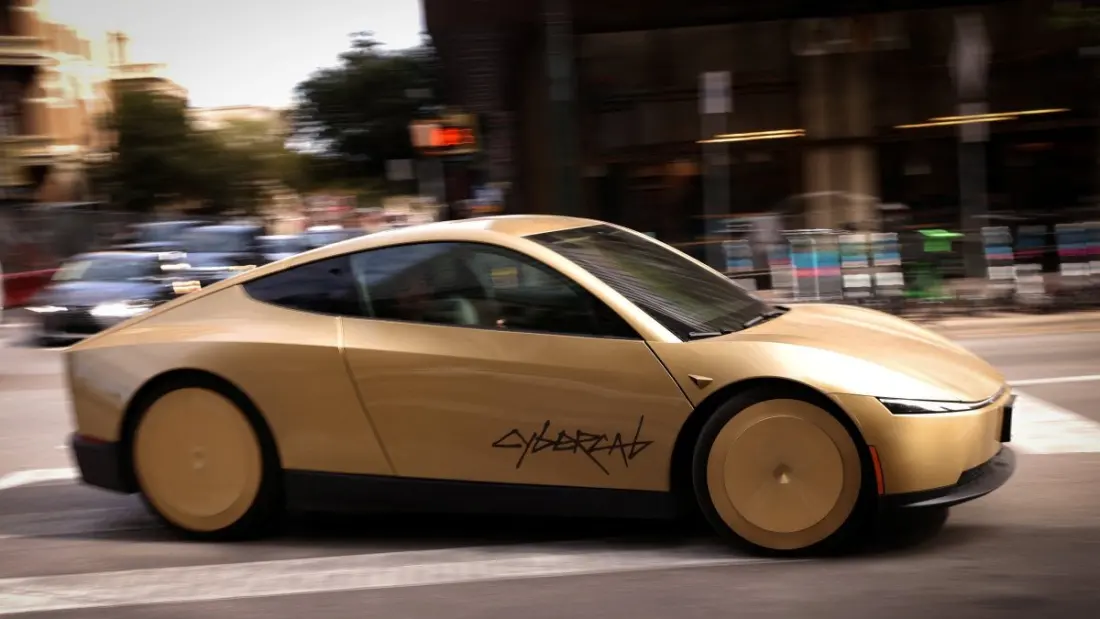
Tesla has started inviting a small group of customers to buy the Cybercab outright — the first time its purpose-built driverless vehicle has been offered for personal ownership rather than fleet use. The starting price is $29,990 before taxes, with deliveries expected to begin in December.
The car itself is unlike anything else on the road. Revealed by Elon Musk at Tesla's "We, Robot" event in October 2024, it's a two-seater with butterfly doors, a large central touchscreen and no steering wheel, pedals or side mirrors. There is simply no way for a human to drive it; every trip is handled by Tesla's autonomous software, summoned and managed through the company's app.
That design shapes an unusual ownership model. On top of the $1,000 nonrefundable deposit, buyers must subscribe to Tesla's autonomy service at $299 a month — a condition of operating the vehicle at all, alongside regular maintenance. Musk has admitted that price is too high and expects it to fall closer to the roughly $115 per month that Full Self-Driving and connectivity cost on other Tesla models. More limiting still: a privately owned Cybercab will only work inside Tesla's designated robotaxi service zones. Step outside those areas and the car's core function stops.
Those zones currently cover a handful of Texas and Florida cities. Tesla launched unsupervised robotaxi rides in Austin in June 2025, added Dallas and Houston in April 2026, then Miami in July, with Orlando, Tampa and Fort Worth following. Musk says personal sales will spread nationwide as regulators sign off.
Regulators are watching closely. In September, the US National Highway Traffic Safety Administration opened an audit inquiry into how Tesla self-certified the Cybercab as compliant with federal safety standards despite lacking conventional controls. The probe is not a finding of any violation, but existing rules remain in force while it runs.
The competitive backdrop matters too. Waymo, Alphabet's driverless subsidiary, now offers fully autonomous rides in 14 US cities including San Francisco, Los Angeles, Phoenix, Miami, Dallas and Nashville, with more expansions announced.
Why should a traveller care? If you're heading to Austin, Miami, Dallas or another robotaxi city, driverless rides are quietly becoming a normal way to get from dinner to hotel — and competition between Tesla and Waymo should mean more availability and better pricing. For anyone considering actually buying a Cybercab, the practical takeaway is simpler: the sticker price is only half the story. Between the mandatory subscription and the geographic limits on where the car can operate, ownership only makes sense inside an active Tesla service zone — and Tesla's own CEO expects the running costs to come down, which argues for waiting.