
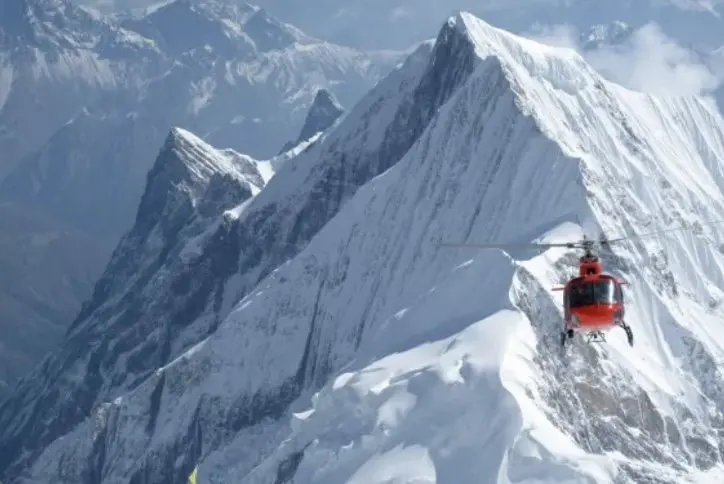
At nearly 7,000m on Annapurna I, a helicopter has almost no performance margin. Wind gusts bounce the machine around violently, and a longline rescue shouldn't work. On April 29, 2010, it did — three times.
The story began as a training exercise. Swiss Air Zermatt pilot Daniel Aufdenblatten, 35, and mountain guide Richard Lehner, 38, were in Nepal teaching Fishtail Air crews high-altitude rescue techniques. Then came the distress call from the world's 10th-highest mountain.
A Spanish expedition led by Carlos Pauner had climbed the North Face of the 8,091m peak without bottled oxygen, summiting on April 27. The descent fell apart. Bartolome Calafat and Lhakpa Sonam Sherpa lost the trail in darkness and stopped at about 7,600m. Calafat could no longer stand; by 9pm he couldn't speak. He survived two exposed nights but died there — doctors later attributed it to exhaustion, dehydration and hypothermia, not cerebral edema. Back at Camp 4 (6,950m), the situation was barely better: Juanito Oiarzabal had frozen feet and failing eyesight, Pauner's hands and feet were frostbitten, and Romanian climber Horia Colibasanu, who had made the first Romanian ascent that same day, had spent a day and a half at extreme altitude staying to help. (He'd done the same for his friend Inaki Ochoa de Olza on this mountain two years earlier.)
The rescues themselves were brutal. On early approaches, Lehner hung under the helicopter for roughly ten minutes breathing improvised nasal oxygen while wind threw the machine around. The crew then stripped the AS350 B3's doors and seats at Base Camp, and Aufdenblatten flew solo: hover, drop a 25-30m line, and have each man clip in with a carabiner before wind or engine power forced retreat. Oiarzabad missed the swinging line on his first try. Colibasanu guided his companions through the process, then hooked in last. All three were flown down to about 4,000m for treatment. The two Sherpas walked down themselves.
It was the highest longline rescue ever completed at the time, and it shifted Himalayan thinking: above a certain altitude, climbers no longer had to get themselves down alone. Aufdenblatten and Lehner received the Aviation Week Heroism Award in 2011, and Aufdenblatten now leads Air Zermatt as CEO. The season carried sadness too — that autumn, Nepalese pilot Sabin Basnyat, whom the Swiss pair had trained, died on a rescue mission when his helicopter hit Ama Dablam.
For travellers, this is a cornerstone story of the Annapurna region — one that explains both the region's danger and its remarkable rescue infrastructure. If you trek to Annapurna Base Camp, you're walking into the landscape where this unfolded, and knowing its history adds real weight to the spectacular amphitheatre of peaks around you. It's also a reminder of why helicopters there are not a convenience but a lifeline, and why serious altitude always deserves respect.
ExplorersWeb