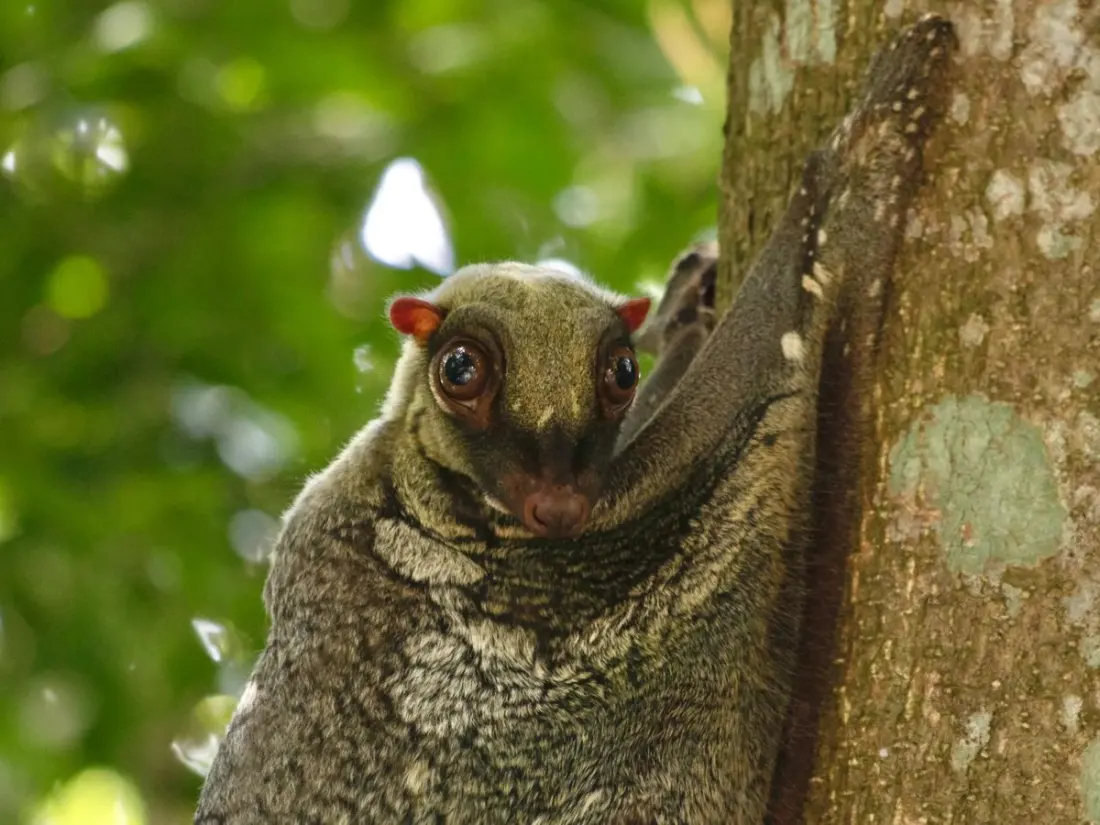
There's a mammal in Southeast Asia that looks like a lemur, glides like a flying squirrel and hangs so still against tree trunks by day that even experienced guides walk past it. It's the colugo, nicknamed the 'flying lemur', and it belongs to an entire order of mammals, Dermoptera, with just two living species: the Sunda colugo and the Philippine colugo.
Despite the name, it doesn't fly and it isn't a lemur. It's a glider, and possibly the most committed one in the mammal world. A stretchy skin membrane called a patagium runs from its neck down its flanks, between its legs, out to the tail and even around its fingers and toes. When it leaps, that membrane turns it into a living kite. Colugos have been recorded gliding around 150 metres between trees, which means they can cross large chunks of forest without ever touching the ground — safer, and far cheaper in energy than climbing down and up again.
The oddities don't stop there. Its lower teeth form fine comb-like projections, known as toothcombs, which it uses like a grooming brush to keep that huge membrane free of dirt and insects. It's mostly herbivorous, feeding on leaves, flowers and fruit under cover of darkness, with big eyes built for low light and sharp claws for gripping bark.
For travellers, the good news is that you don't need to trek into remote jungle. Singapore is one of the easiest places to see the Sunda colugo, with sightings recorded at Bukit Timah and the Central Catchment Nature Reserve — both reachable on public transport. The Sunda colugo also ranges across parts of Indonesia, Malaysia, mainland Southeast Asia and Singapore, while the Philippine colugo lives in the southern Philippines.
Spotting one takes patience. They're nocturnal and their mottled brown-grey fur blends remarkably well with tree bark, so scan trunks slowly during the day for a lumpy shape that looks like part of the tree, or return after dark and watch the canopy for a silent silhouette sailing between trees. A local night walk or guide dramatically improves your odds.
There's also a scientific twist worth knowing: a 2016 genomic study found big genetic differences between isolated colugo populations, hinting that two species may actually hide far more diversity than current classification suggests. In short, the colugo is one of evolution's strangers — a primate relative that picked gliding over leaping, and ended up in a category of its own.
If your next Southeast Asia trip includes a night walk in Singapore's forests, keep an eye on the treetops. You might catch the region's quietest acrobat mid-glide.