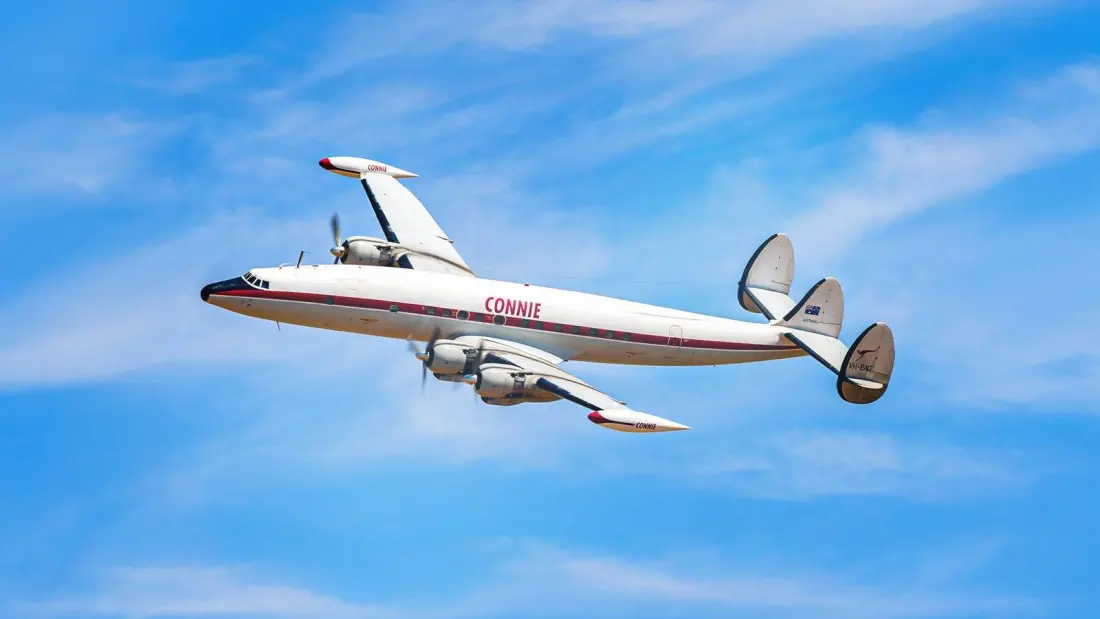
One of the most recognisable airliners ever built — the Lockheed Constellation, with its curved fuselage and three vertical fins — owes its famous silhouette to something utterly unglamorous: the height of TWA's hangar doors.
In 1939, Howard Hughes approached Lockheed with demanding specs for a new long-range airliner: a 6,000-lb payload, 3,500 miles of range and a cruising speed above 250 mph at 20,000 feet. That called for a big, heavy, four-engine aircraft with tall landing gear to clear the huge propellers of its Wright R-3350 radials. A conventional single tail fin big enough for directional stability would have made the aircraft too tall for TWA's existing maintenance hangars — so Hughes simply required that it fit inside them.
Lockheed's engineers, chief engineer Hall Hibbard and a 29-year-old Kelly Johnson, split the required fin area across three shorter stabilizers, holding overall height to 23 feet 8 inches. The triple tail even had an aerodynamic bonus: the outboard fins sat in the propeller slipstream, improving low-speed stability and yaw control during engine-out situations. The trade-off was extra weight and mechanical complexity — three rudders, more cables and actuators — penalties the rival Douglas DC-6 never paid with its single fin.
The story of the aircraft itself is just as eventful. Its first flight in January 1943 came as the military C-69, after Pearl Harbor redirected production. In April 1944, Hughes and TWA president Jack Frye flew one from Burbank to Washington in under seven hours; on the return leg, Orville Wright boarded for the last flight of his life, remarking that the Constellation's wingspan exceeded the distance of his first flight at Kitty Hawk. In commercial service from 1946, the pressurized Constellation cruised at 340 mph, well above the unpressurized DC-4, and triggered a fierce decade of development against Douglas. Lockheed built 856 before production ended in 1958 — the same year the Boeing 707 made propeller airliners obsolete.
For the aviation-minded traveller, there's still a chance to see one fly. Of roughly 55 surviving Constellations, only two are airworthy as of 2026: VH-EAG, a Super Constellation in Qantas colours operated by Australia's Historical Aircraft Restoration Society at Illawarra Regional Airport, and Bataan, a VC-121A once used by General MacArthur and later NASA, which appears at US airshows. Fun fact to deploy at the hangar: Johnson went on to found Lockheed's Skunk Works, home of the U-2 and SR-71.
It's a neat reminder that great design often comes from constraints — the triple tail vanished from commercial aviation once hangars grew to fit jets, and the problem it solved simply stopped existing. Story credit: Simple Flying.