Somewhere on a long, empty highway in the American Southwest, a travel writer spent six hours driving with an unusual companion: the Mancos Shale. Not a person — a geologic formation. This gray-blue-brown mudstone shows up again and again along roads through New Mexico, Arizona, Colorado, Wyoming, and Utah, and once you notice it, you start seeing it everywhere.
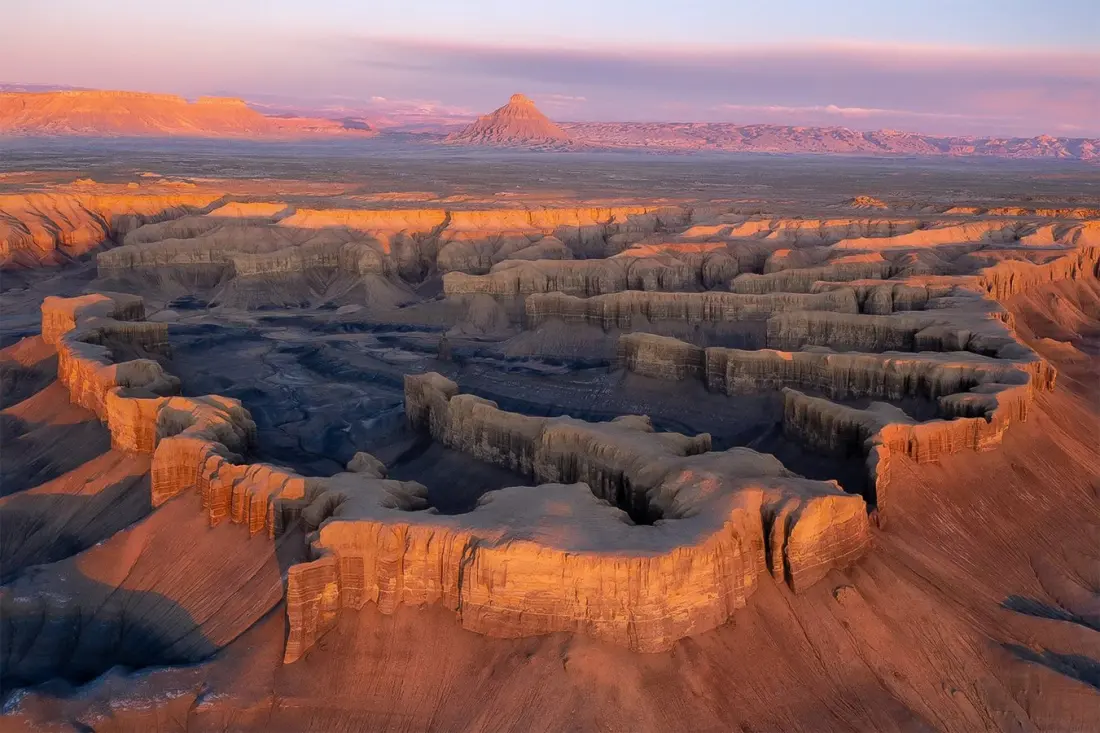
The Mancos is old in a way that's hard to wrap your head around. It was laid down in the Late Cretaceous, roughly ninety million years ago, when a vast inland sea covered much of what is now the American West. The sediment that settled on that seafloor eventually hardened into a soft, crumbly mudstone — geologists call it "friable," meaning it falls apart easily — which is why it erodes into those smoky badlands, gentle slopes, and muted gray-brown hills that give big stretches of the Four Corners region their distinctive, almost lunar look.
Why should a road-tripper care? Because understanding even a little of the geology transforms the drive. What reads as boring, empty desert from the interstate is actually the floor of an ancient ocean, streaked with fractal erosion patterns in the dirt. The same soft rock that makes the Mancos visually striking also makes it unstable — it's notorious for slides and road damage, which partly explains why some of these highways have that perpetually under-construction feel. And in towns like Moab or across the Colorado Plateau, the contrast between the pale Mancos layers and the harder, redder sandstones above and below is what creates many of the region's signature striped cliffs and mesas.
The practical takeaway: if you're planning a Southwest loop — say, New Mexico to Utah via Colorado — build in time for stops, not just miles. The landscapes that look monotonous at 70 mph reward a slow look. Short hikes onto Mancos badlands, viewpoints along Highway 550 or Route 191, or even just pulling over where the mudstone breaks into strange rippled patterns can turn a transit day into the most memorable part of a trip. Bring water, sun protection, and shoes you don't mind ruining — that crumbly shale gets everywhere.
It's also a reminder of what makes desert road trips different from other kinds of travel. With no scenery-change every few minutes, the reward comes from paying attention to subtlety: shifting hues of the same stone, the way light moves across eroded slopes, the deep time compressed into a roadside cut. The writer's point lands well — you're never really alone out there. The landscape itself is entertaining company, if you let it be.
For anyone plotting a route through the Colorado Plateau or the Four Corners this year, a little background on formations like the Mancos turns a long drive into a moving geology lesson. Cheap, self-guided, and available at any speed you like.